STEVE JACKOWSKI

fr.stevejackowski.com (site en Français)

  • Life & Work
  • Novels
    • The Inflection Point
    • The Swimmer
    • The Misogynist
    • The 15th Juror
    • The Shadow of God
    • The Silicon Lathe
    • L'Ombre de Dieu
    • Ethics
  • Blog
    • Electric Vehicles (EVs)
    • France
    • Personal
    • Sports
    • Startups
    • Work in Progress
    • Writing
  • Reviews
    • The Misogynist
    • The Shadow of God
    • The Silicon Lathe
  • Picture Gallery
  • Contact
  • Work in Progress

Why I hate Daylight Savings Time

3/14/2016

0 Comments

 
Picture
Okay.  I'll try to keep this from being too much of a rant, but the truth is, I hate Daylight Savings time.  I hate it most here in the United States.  I may not like it much in other countries, but the US version makes no sense at all. 

Of course I know all the arguments in favor of Daylight Savings time.  It saves energy.  It helps tourism and leisure businesses as people stay out playing later.  It reduces car accidents during later commute hours.

But did you know that more people die of heart attacks, strokes, and car accidents in the days after a time change?  How about the fact that kids have to go to school in the dark, or that early commuters have more accidents.  Worse, here in the US, the 2007 change that took us out of step with most of the rest  of the modern world actually reduced the energy savings we had before. 

Daylight savings time has been around a long time.  Ben Franklin is often credited with the idea, but from what I've read, this was from an article joking that Parisians could benefit from getting up earlier.   It didn't get officially implemented until over a century later.  Most of modern Europe adopted it in 1916 and the US quickly followed suit, matching the times of year for turning your clock forward and back.  During World War II, the US went on War Time - Daylight Savings Time ran year-round. 

In the 1960's the US and most of the Europe coordinated their Daylight Savings time.  If you're going to have it, this makes sense. 

But then in 2007, the US decided to advance the change in the spring by 3 weeks and delay the return to Standard Time in the fall by a week.  I wasn't happy with the idea before, but this just seemed insane. 

First, it took us out of step with the rest of the world.  And of course it meant that more kids had to go to school in the dark for longer in the year.  The US Department of Energy conducted a study that showed this change had ZERO benefit, and subsequent studies proved that although a trivial amount of energy for light was conserved, there was a substantial increase in the demand for heating, far offsetting any potential benefit. 

I know, I'm biased.  I'm an early riser and like to be in the surf at sunrise.  I hate the fact that in March, I can't get in the water at 6am.  But what really gets me about Daylight Savings time is how illogically it's implemented. 

Let's think about this in terms of its goal - to take more advantage of daylight hours.  Sure, near the summer, particularly in northern latitudes, it makes sense.  Very few people get up at 4:30 in the morning, so why not make the sunrise 5:30am and give us more light in the evening.  I get it. 

But in Winter?  As far as I know, it's still winter. 

Look, if we're going to have Daylight Savings time, it should be symmetric with respect to the solstice.  The winter solstice is the shortest day of the year and the summer solstice is the longest day of the year.  Right now, we start Daylight Savings Time about 10 weeks after the winter solstice.  Europe starts 3 weeks later.  We end Daylight Savings Time about 6 weeks before the winter solstice.  This is crazy.  If it was too dark to start Daylight Savings less than 10 weeks from the darkest day, why would you wait to end it until 6 weeks before the darkest day? 

I heard one argument that the US extended the ending date to make it more light for kids on Halloween.  Who goes out trick or treating when it's light? 

Aside from the loss of early surf sessions and the confusion working with other countries caused by the inconsistent time changes in the US, the lack of any proven benefit to that 2007 change, and the studies that show it has actually caused harm, suggest to me that we should at least go back to the policy from before 2007, or better yet, revisit the whole idea of Daylight Savings Time.

0 Comments

Why I Outline My Novels

3/10/2016

0 Comments

 
Picture
Writing a novel is supposed to be creative and cathartic.  It's the ultimate expression of great stories through your ideas, emotions, and deep thoughts framed with human drama and moments of humor.  But getting from that first blank page to a work of 300 or more pages is intimidating, even if you've done it before.

When I started my first novel,  The Silicon Lathe, I knew I wanted to tell a semi-autobiographical tale of my life as a young entrepreneur starting out in the Silicon Valley.  After a long career filled with my experiences  of  innovation, creativity, and altruism confronting ambition, greed, manipulation, and downright evil, I knew I had more than enough material for a novel, probably several.  Wherever there's money to be made you will find the best and the worst in people. 

And I was lucky.  Since the novel is about the history of the Silicon Valley, I could just start at the beginning of my career and finish at the end.  To bring the proper context to the reader, I took the logical approach of opening each section with the year's global events.  It was easy to put together a simple outline for the book. 

When I wanted to add sections about extreme sports and juxtapose them with the challenges, successes and failures, all I had to do was insert them in the proper places. 

My second novel, Ethics (unpublished), was a cathartic book.  I started by writing the first and last chapters, then worked from back to front to fill in an outline.   I poured my heart into the novel  and often found myself writing long emotional diatribes.  My early readers pointed out that I'd gone a little far with most of these and suggested some trimming or perhaps more accurately, some serious clear cutting.  But with the outline, this clean up was easy to do and Ethics is arguably my best work to date. 

With The Shadow of God, an outline was essential.  This was my first foray into the mystery/psychological thriller genre.  Imagery was a key part to very subtle foreshadowing as were the clues that I dropped in each section.  As the San Francisco Book Reviewer said:

"Jackowski lays out the information in such a way that everything is in place long before you discover it. This is a very smart book, perfect for both readers who like to try to solve the crime before the characters do and readers who love to reread mysteries to see all the hints early on."

The outline enabled me to decide where to put the clues and even to move them around when I made organizational revisions.   Even better, when I was well into the book and wrote something that required corresponding changes earlier on, those places in the book were easier to find using the outline - certainly easier than searching for key words or reading for situations whose locations I couldn't quite remember months later. 

Unfortunately, in my latest novel, I decided to try to write it without an outline.  It hasn't gone well.  I've written sections to introduce each of the main characters, have set up several ominous situations, have laid down hints to start leading the reader astray, but the fact is, since I'm not sure where I'm going, it's kind of hard to bring the reader along.  I find that I have too many options.  I start down a path, then backtrack or second guess myself.  It has taken me far longer to get less than 25% done than it did to write an entire outlined novel.  I'm starting over with an outline and will refine it to a couple of levels before I start continue writing this book. 

What I've learned is that outlining is not just an organizational tool.  It forces you to think through your story and to make decisions so that when you're heads down, you know where you've got to get to.  Even better, when you hit a block on a particular subject or character, you can just decide to write a different section and come back to the difficult one when you're ready.  

Unlike a building, where you need to lay the foundation before getting into the heavy construction, as a writer, if you have an outline as your plan, you have the freedom to construct the story and then to come back to lay that foundation with clues and foreshadowing.  

For me, the outline is my safety net.  I won't write without one again.

0 Comments

#Startup - When Should You Throw in the Towel?

12/22/2015

1 Comment

 
Picture
Most of my posts on #startups have focused on how to avoid making mistakes that may lead to failure.  My first post, How to Build a Startup Company - Part 1,  asked some fundamental questions about your motivations when looking at undertaking a startup.  Subsequent posts tried to get you thinking about viability of your product or service, business planning, hiring the right people, and management skills. 

But the reality is that even if you do everything right, there's a chance that you'll fail.  Sometimes markets change.  The economy can turn.  An unexpected competitor may arise.  You or a critical team member may become seriously ill or have an accident.  There are countless disasters awaiting a new startup.  And many very successful entrepreneurs admit to having failed multiple times before finally achieving their dreams. 

You need to be prepared for possible failure.  If not, you could lose more than your business.

As I described in earlier posts, building a startup is not only hard on you, it's hard on your family and those around you.   You'll spend too much time away from your spouse and children.  You'll be interrupted at the worst times and often need to be available 24x7.  Relationships suffer, divorces frequently follow. 

It gets worse if you fail.  Your confidence will be shaken.  You may get depressed.  You could be even less available to those who care about you.  

But absolute disaster strikes when you've led  yourself and your family into financial ruin.  No more savings, no more retirement monies, no more equity in your home, you've raided your kids' college funds, you've run up credit card debt, have no income, no prospects for a job, and no funds to do another startup.  As ridiculous as it may sound, you could end up on the street.  I've seen it happen.  You can't let it go that far.

To use an overused boxing analogy, you need to know when to throw in the towel. 

So, how do you know when to give it up?

In an ideal scenario, you would make this part of your business plan.  Just as you set milestones for success, you should set checkpoints to assess possible failure.  You need to draw lines you won't cross.  These will be different for everyone depending on their financial and family situations. 

  • If you're single with few responsibilities, and know you can always get a job, you can probably risk it all.
  • If your kids have left home and you have a nice nest egg for retirement, you can take some risk but need to know where to draw the line.  You don't want to burn through your retirement monies only to find you can't get another job.
  • If you have kids living with you, you need to be much more careful.  You should determine how much risk you and your spouse are willing to take, and with regular checkpoints, when you need to give up on your startup.  It might be a period of time, a certain amount of money spent, how much time the business takes from your personal life.  It could be many things.
This may seem obvious, but when you're in the heat of it all, when you're fighting to keep your company alive, when you're sure that if you borrow from your retirement monies or take out an equity loan on your house, you'll be able to save your business, you usually won't see that you're about to go too far.   It's hard to step back and take an objective look when you're under live fire.  But you MUST do it.

If at all possible, have an uninvolved observer look at your situation regularly.  It could be your board of directors, a friend you trust.  It might be your spouse. 

In my lengthy career, I've seen many disastrous business failures that ruined peoples lives. But I decided to do this post now because of two recent startup failures.  The first involved a person with no family obligations.  Unfortunately, she didn't draw that line and ultimately burned through savings, retirement monies, and equity, losing her business and owing the government a lot of money.

The second involved someone with a family who originally promised to give his dream a year.  He had sufficient monies to keep it going that long and wanted to see if he could make a living out of what had always been a recreational passion. 

But at the end of a year, monies were not flowing in.  Many of his targeted milestones had not been achieved.  Could he really give up his fledgling startup after investing a year and getting others committed to his vision?   When he told me he was thinking of dipping into his retirement accounts, I sent him a list of questions about what he'd learned about himself and his business opportunity over the past year.  Fortunately, he did an honest assessment of his strengths and weaknesses and determined that at least for now, in the way he's approached it, he wasn't going to be able to support his family via his new venture anytime soon. 

He'll continue to try to build the business part-time, but he's not betting everything on something that's not ready to support his family.  He's now interviewing for positions that will enable him to make a good living.  This was a wise decision.

Don't get me wrong.  I'm not suggesting you plan for failure.  However, I think it's critical for you to establish limits on the risks you're going to take.  And somehow, you must find a way to objectively assess where you are and avoid a failure that could destroy not just your business, but your family and your life.  Don't let yourself believe that even though you've missed your goals, if you just put more money and time in, you can save your business. 

You're much smarter if you can walk away before disaster strikes and as the old saying goes, live to fight another day.
First Build your Startup Post
Build it or Buy it - Which should your #startup do?
1 Comment

Translation Complete.  Now the Hard Work Begins.

12/4/2015

0 Comments

 
Picture
The translation of The Shadow of God is finally done - at least we're done with the first pass.  For those of you who may not have followed our progress on this effort, you might want to have a look at Translating My Novels and Another Translation Challenge: Shaggy Dog Stories.  These two posts discuss the approach that Peyo Amulet and I took and some of the initial challenges we encountered. 

Overall, it has taken about a year to get through our process.  Of course Peyo had other translation projects to work on so he wasn't on this full time.  Plus, our process allowed for a fair amount of down time.  Essentially, it went as follows:

  • Peyo would translate 50 pages on his own, run them by a fellow professor of French,  and then email them to me.
  • I would read the 50 pages carefully, making comments on anything that needed attention: typos, misunderstanding of certain colloquial expressions, issues with tone and imagery.
  • Peyo and I would meet in person or via Skype and would review and discuss each change.  Usually it took about 3 hours to get through 50 pages - some of our discussions turned into debates, usually about tone, style and how pacing needs to change in French.
Among the open issues we had were what to do with the Shaggy Dog Stories, final formatting of dialogue, and language.  Often Peyo would push for more formal/literary language, where I was pushing for more colloquial French, particularly with dialogue. 

For the Shaggy Dog Stories, we finally decided to translate them into French, then to add a footnote to explain the play on words in English.  I think this reads well. 

We got through the final 50 pages in October and began the somewhat arduous process of reassembling and reformatting the document.  It may seem like a minor issue, but in French, quotation marks are followed by a space.  Question marks, exclamation points, colons, and semi-colons are preceded by a space.  While MS Word inserts these for the French Language, the version of Word that Peyo used would line wrap them and sometimes we'd end up with a question mark, exclamation point, colon, etc.  alone on a line.  Or they'd split oddly across lines.  I finally figured out how to force Word to use non-breaking spaces with these characters and the document cleaned up nicely.

I forwarded the reassembled book to a French friend and she tore through it, finding countless typos and making a number of suggestions.  Peyo reviewed and incorporated these and today, I sent copies out to a well-known French author and to two friends who claim to be Monsieur and Madame Tout-le-Monde.  They wanted to be among the first to read the book. I've asked them to be brutally honest.  Specifically, I want to know:
  • What do they think of the story (of course)?
  • Do they think it would appeal to a French audience and if so, who would like it?
  • How is the translation - does it come across as too literary for a psychological thriller?  Did the dialogue match up with the characters and their personalities? 
With luck I'll have their comments back in a few weeks.  While waiting, I'm searching for someone who can redo the front and back cover to replace the English.  Then Peyo and I will make one more pass before seeking a French publisher.  We also need to create a French web page for The Shadow of God (now L'Ombre de Dieu) on this site or perhaps even create a French version of the entire site.  After all, if it goes well for L'Ombre de Dieu in France, I'll want to translate The Silicon Lathe, and Ethics (which I might actually publish there).  Clearly there's still a lot to do.

Wish us luck!
0 Comments

Build it or buy it?  Which should your #startup do?

7/16/2015

0 Comments

 
Picture
Hoping to accelerate the time to get his service business going live,  one of the entrepreneurs I'm working with recently asked me whether he should have developers build software, find a third party who could deliver something sooner, or find open source software that the developers could customize. 

Of course, I said it depends. 

Obviously it depends on cost versus the benefit of time to market, but there are other considerations including impact on your staff, your support plans, and perhaps most important, your exit strategy. 

Although most entrepreneurs are faced with this decision at some point and most have no problem making a good decision, I thought I'd jot down a few considerations just in case there's something you might not have thought of. 

Build it yourself

I must admit that in all of my companies, we built our own products.  This was largely because our initial products were 'under the covers' - inside operating systems and invisible to users.  At the time, there really weren't any off-the-shelf solutions that we could use as the basis for what we were building.  In fact, most of our products were these tools that others could use to build their products. 

This approach worked well for us for the following reasons:

  • We had complete control over the features and implementation of the products.
  • We understood the products completely so our support efforts were reduced.
  • Because of our modular development, the products were easy to enhance.
  • At the time of our exits, there were no questions about the ownership or licensing of our products
Of course we had to pay for development and it took more time to get to market, but for us, this approach worked out well.

Using Open Source Software

In my last company, we moved from tools to end-user products and since we weren't the strongest in building beautiful user interfaces, we took advantage of publicly available open source software that was subject to the GNU public license (GPL).  This sped up our development substantially, and since we had a solid proprietary base, the addition of the open source code presented little risk to our products.  We kept the code modularly separate from our main code so we were able to avoid some of the more restrictive aspects of the GPL.  The main advantages to this approach were:

  • It saved us a lot of development time.
  • The code was open source so we could change and modify it at will - we had complete control over the code.
  • The user community helped us with support issues.
  • It was free.
The way we handled it presented minimal risks, but there were disadvantages:

  • The GPL required us to publish and make available all changes we made to the code.
  • There were some occasions where the user community couldn't help us with support issues.
  • Upon acquisition, the acquiring company had to do a careful examination of all GPL code we used, the changes, and the interfaces to our core software.  They needed to ensure that there was no exposure to their products which would incorporate ours.
Because we were careful and knowledgeable in how we used the open source code, it worked to our advantage, advancing our time to market while preserving our control of the code, and presented only minor issues during our exit (acquisition).

Buying/licensing from a third party

Although we never bought components from a 3rd party to incorporate into our products, we were one of the third parties that sold components and tools to others to help them get to market quicker.  Our products were closed to the buyers.  That is, they bought functionality and we provided external interfaces.  We never supplied source code and they never needed it. 

From our perspective (and theirs since they paid us), buying from us had the following advantages:
  • Very rapid time to market.
  • A professional organization who guaranteed responsive support.
  • No requirement to hire expertise they didn't have or want to have longer term.
As it turned out, well more than half of our customers were acquired by larger companies.  Because we had assignment clauses for our licenses with clear explanations of what that meant in terms of fees and rights, all of these deals went off without a hitch.  And of course, we were happy to welcome these much larger companies as our new customers. 

So, if you're faced with the choice of build it yourself, use open source, or buy from a third party, each can work:

Build it yourself if you have the expertise and can afford to take the time to debug before getting the product/service to market.

If you need quicker time to market and have some expertise in-house, try for open source.  Be sure to keep the open source separate from other components of your offering if at all possible and to follow the GPL rules about publishing.

If you need to get to market as soon as possible, and don't have a lot of expertise in development, consider licensing from a third party.  They can give you a leg up.  Ensure that you have solid enforceable agreements for customization and support, and that assignment clauses are clear and wouldn't scare off a potential acquirer.  Also, vigorously negotiate the license fees.  Most companies are more flexible than you might imagine and many are willing to 'invest' in new ventures for back-end payments upon success.  If possible, get source code/designs.  In the worst case, ask for an escrow in case the company should go out of business. 

But whether you make it yourself, get a leg up from open source, or license a product, ultimately the packaging and presentation is yours.  You're also the face on the support.  From the public's point of view, this is your product/service.  Own it!
First Startup Post
#Startup - When Should you Throw in the Towel?
0 Comments

Dare Brittany! Finistere, Morlaix, Perros Guirec.

7/14/2015

1 Comment

 
PicturePouldreuzic and Perros Guirec
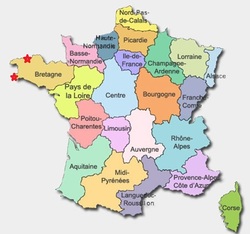
Dare Brittany!  That's the motto that the tourist boards are promoting in Brittany, France.  And from our experiences there, we understand where they're coming from.  Brittany is unique.  It's more rugged.  The people are tougher.  Even the bread is heartier.

Like the Basques from our favorite region of France, the Bretons had a longstanding separatist movement and still maintain their own language.  Many of the road signs are in two languages.

While Quiberon is in Brittany and fascinated us with its varied coastline and nearby prehistory, I don't think we were quite prepared for Finistere.   It was much more stark than we had imagined - almost bleak.   I had heard a lot about La Torche, the surf break with its famous Ascenseur (Elevator) - a current that runs at up to 8 miles per hour and is great for propelling you back to the lineup but we really weren't expecting any waves as the surf forecast wasn't promising.  However, with our great introduction to Brittany in Quiberon, we had high hopes for this more remote area. 

Even the names of the towns seemed intriguing.  Lot's of 'P's and apostrophes in names like Penmarc'h, Pouldreuzic, Plozevet, and Pluguffan. 

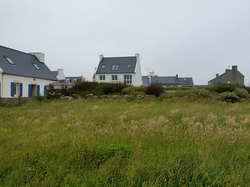
PictureHomes in Pouldreuzic
We drove through craggy rolling hills, crossing rivers, and rounding the larger city of Quimper.  Suddenly the roads narrowed - all routes seemed to be single-laned.  There were fields but they all seemed to be fallow - nothing was planted - and it was the end of May!  We saw very few houses, just lots of open countryside.   Nothing really changed as we neared the coast and approached our hotel.  However, the architecture of the homes was quite different.  As we later learned, the homes were built for multiple families and their animals - to shelter them from the harsh winters.  Then, there it was - a completely incongruous building with neon lights - the Breiz Armor.  Although the hotel was nice in a Best Western sort of way, it seemed completely out of place on Penhors plage which is officially part of Pouldreuzic.  We decided to cancel our dinner reservations and to search the nearby towns for a more 'authentic' place to eat.   

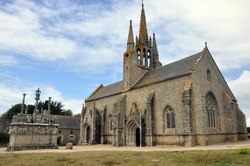
PictureTronoen Chapel with Calvary (on the left)
Continuing on the small country roads, we found some charming villages and ultimately a good restaurant.  On our way back just after sunset, out in the middle of nowhere, we passed what looked like an ancient chapel.   In the dim light, we discovered that outside this chapel was one of the oldest and most famous calvaries -  large granite sculptures which depict the life of Christ - from before birth to crucifixion and the resurrection.  One of the most notable things which I found indicative of the attitude of 15th century Brittany (it was built about 1450), was a sculpture of Mary giving birth - breasts exposed.  I'm surprised this wasn't considered blasphemous but again, I think it bespeaks the practical, down-to-earth nature of the Bretons of the time.  It was getting dark and our pictures didn't turn out well, so the one at left was borrowed from the Wikepedia site. 

Picture
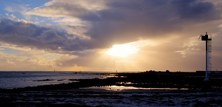
Sunset from Penmarc'h
Picture
Tortured coastline from GR 34
Picture
Finistere Menhirs
In the morning we got up and did a hike along the GR 34.  At over 1600 kilometers, this is one of the longest Grande Randonnees in Europe.  It was a cool drizzly morning and we made our way along the tortured rocky coastline to the north.  To the south there were miles of sand dunes.  Along the trail, there are signs about the area.  Many explain the harsh life of the Finistere Bretons, most of whom made their livings harvesting kelp, then submitting it to an arduous process to extract iodine for sale.  It was a meager living at best.  They also talked of shipwrecks - not from centuries ago, but from the 20th century.  While this group of Bretons knew the ocean, the rocky coast, radical tide changes, and severe weather cost many their lives.

PictureThe town of Morlaix
After a bit more exploration of this bleak part of Finistere, we continued our trip  towards our next destination, Perros Guirec.  Along the way we passed though a spectacular national park of rocky cliffs and pine forests, then decided to stop for lunch in Morlaix, hometown to one of our French friends.   The town is built in a canyon carved out by a small river.  On the north end is a harbor which is inland from the coast.  We'll definitely return to do more exploration of Morlaix.

PicturePerros Gueric sunset
Arriving at our hotel in Perros Guirec, we were blown away.  The  Hotel Manoir du Sphinx is built into the side of a cliff that looks out onto the seven islands.  It sits half way between the two main areas of Perros Guirec - a harbor to the east and a long beach to the west.  We went for a walk to do some exploring and found the people very friendly - even more reminiscent of the Basque region where everyone you pass says hello.    We had an excellent meal in the hotel's restaurant and explored a bit more of the town afterwards.

Picture
Starting our hike along the GR 34
Picture
Pink Granite Formations
Picture
Looking back at Perros Guirec
The next day we did a hike towards the west on the GR 34.  This section of the Grande Randonnee features spectacular pink granite rock formations.  The trail itself follows the ancient Sentier des Douaniers - trail of the customs agents.  Along the trail there are small structures built of pink granite that are camouflaged among the rocks so that the custom agents could spy on smugglers. 

After several miles, we turned back passing through the village of Ploumanac'h, and then catching up to the GR 34 again.  There was some small crowded surf in the afternoon but I decided to pass.  That evening we had another fantastic dinner, this time at La Suite overlooking the beach in western Perros. 

For breakfast the next morning, we stopped at a artisanal bakery where we found some of the best bread we've eaten in France - and that's saying a lot!  We're big bread fans and the French with their 3-4 bakes a day supply some of the best, freshest bread in the world.  But I do love heavy breads like the black breads found in Germany and eastern Europe, so I really enjoyed the hearty fresh bread of Brittany.

In looking back at our quick trip up the west coast of France with our stops in Ile d'Oleron, Olonne-sur-mer, and Quiberon (which is part of Brittany), clearly Brittany wins out.  We felt at home there much as we do in the Basque Region.  Between the history (actually pre-history), the spectacular landscapes, the rugged ocean, the GR 34, and the interesting people, there's much to explore and experience.  Without a doubt, we'll be going back.
1 Comment

Jaizkibel - Hike from a Ruined Spanish Parador

6/26/2015

2 Comments

 
PictureJaizkibel seen from St Jean de Luz looking over Socoa
I've written a few blogs about les Trois Couronnes, one of the majestic peaks that dominate the Pays Basque in France.  I've also mentioned La Rhune, a higher peak to which many of the Basques attribute supernatural occurrences.  These two dominate the skyline to the south.  But there's one more that rises out of the ocean just below the border.  It's called Jaizkibel.  While we know quite a bit about the first two, we'd never hiked Jaizkibel.  It was a Saturday with rain forecast to come in about noon.  I had hoped to hike west of San Sebastian near the town of Itziar - an area called Itxaspe.  The cliffs are spectacular, the rock formations date from ancient periods, and to be honest, it appears there are some 'undiscovered' perfect point and reef breaks there if you're willing to descend the three hundred foot cliffs. 

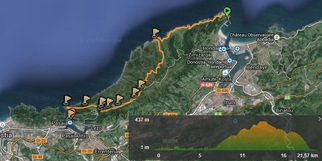
PictureHondarribia to Pasaia
But because of the forecast rain, Martine, our hiking partner, suggested we do Jaizkibel instead.   The mountain is a ridge that borders the ocean starting in the now-trendy Spanish town of Hondarribia.  The ocean side is rough with no roads and only trail access.  The inland side is a valley  With the Pyrenees (and Les Trois Couronnes) just a few miles to the south.  If you start at the lighthouse in Hondarribia, it's 22 km (14 miles) to Pasaia at the other end of the ridge.  Martine proposed we start about half way, at a ruined Parador, given the incoming weather. 

I didn't know anything about Paradors.  In our ten years together, Karen never mentioned that she had stayed in many when she lived in Spain.  Paradors are luxury hotels owned by the Spanish government which are located in old castles, monasteries, estates, and other exotic buildings.  They were built by the government to encourage the economies of out-of-the-way places.   I found a site with a map of the Spanish Paradors and clicked on several to get descriptions of the properties as well as things to do in the surrounding areas.  Karen and I will definitely be visiting a few of these (particularly in Galicia and out near the border with Portugal).

Picture
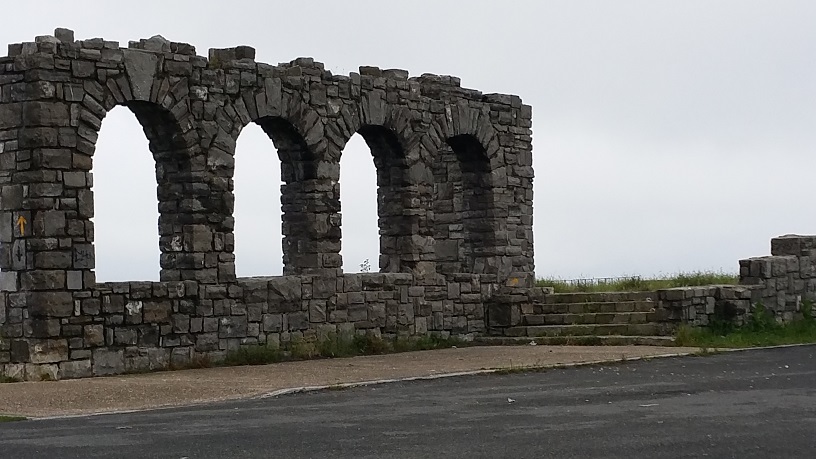
The ruins of the Jaizkibel Parador
Picture
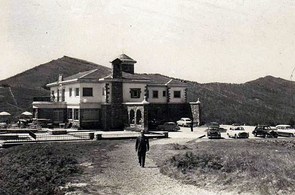
The Jaizkibel Parador before
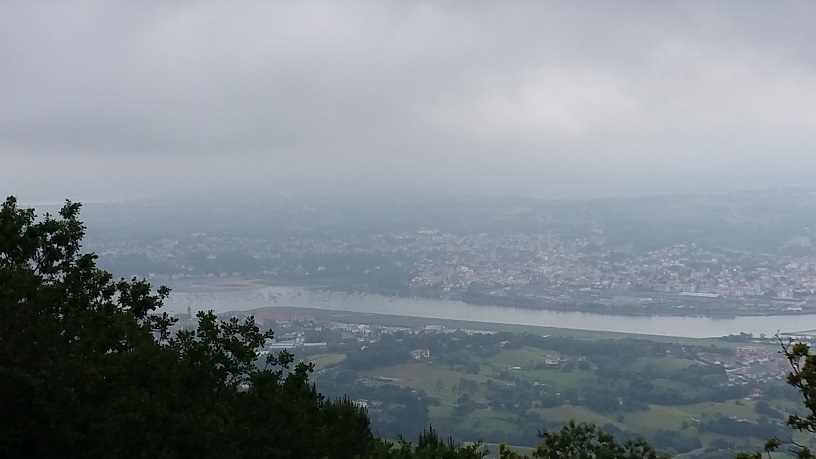
The Jaizkibel Parador was torn down in 1999 and all that's left are some stone structures and part of the foundation.  The views are spectacular.  On the south side, you see the valley with Irun below and the Pyrenees behind.  To the north,  the rugged cliffs below, and to the northeast, Hondarribia, Hendaye, and the coastline of southwest France.  On a clear day you can see much of the way to Bordeaux.  Unfortunately, it wasn't a clear day...
Picture
Looking south (inland)
Picture
France is on the other side of the jetty
Picture
Several ancient sentinels guard the top of the ridge
We started our hike with a descent of about 200' towards the ocean along a closed dirt road.  About a mile later after trying a small trail that led nowhere, we encountered the GR 121 - one of Europe's Grand Randonnees.  This is the 22 km trail I mentioned above.  It is a well-maintained, easy trail with gentle slopes.  We turned towards Pasaia and followed the trail into the mist as we climbed towards the peak of Jaizkibel.  Along the way we had views of the rugged, mostly inaccessible coast below us to the north and off to the west.  There were numerous trails that branched off the GR121 towards the ocean below, but given the impending weather we decided to save them for another day. 

During most of our hikes in the Pyrenees, we've encountered wild horses called Pottoks.  They are small and very tough-looking.  As we climbed, we encountered a group of horses, including a foal, but we weren't sure if they were wild or not.
Picture
The spectacular rugged coastline to the west
Picture
Wild (?) horses
Picture
Martine and Karen heading into the mist
We continued upward thorough a forested area crossed by numerous creeks but decided to bypass the trail that led to the tower-laden peak, choosing instead to follow the GR 121 along the top of the ridge. 

Three and a half miles into the hike, we decided to stop for lunch at one of the ruined lookout posts similar to the one near the Parador.  We set up our lunches and of course, it began to rain, hard.  We wolfed down as much as we could under the improvised shelter of our rain jackets and decided it might be a good idea to head back.  Fortunately, about a mile later, the rain eased up and we got a few sunny breaks.
Picture
A break from the rain
Picture
Along the ridge on the way back
Picture
Heading back toward the Parador
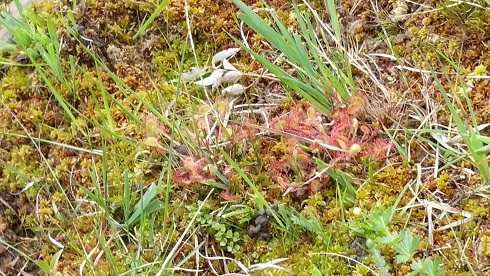
We made our way back through a few sprinkles, but it was clear from the increasing winds that the main part of the storm was on its way.  It had been nice hike of about 7 miles round trip.  In addition to the impressive views, along the way, Martine pointed out a few things of note.  The first picture below is of a very small pinkish plant that is a carnivore.  It secretes a dew-like drop that attracts insects, but is so sticky that they can't escape.  Then the leaves enshroud them.  We were able to trigger the closing with pieces of grass. 

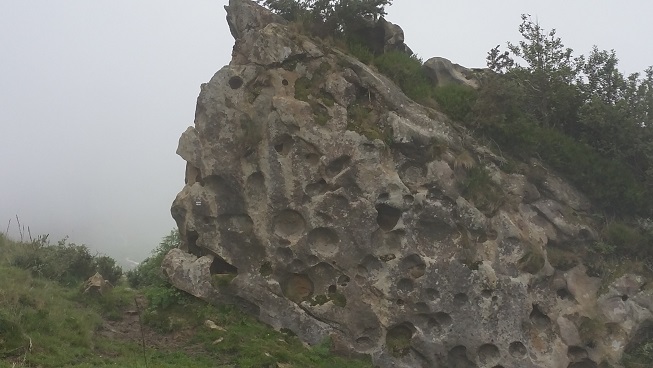
We also encountered some interesting rock formations with large hollows in them.  Martine explained that these volcanic rocks were formed with glass balls inside.  As the rocks erode, the balls become exposed, fall out, then eventually roll all the way to the ocean.
Picture
Low-lying carnivorous plants
Picture
The hollows in the rock used to contain glass
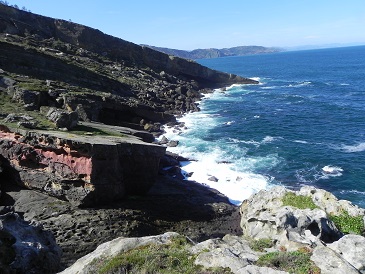
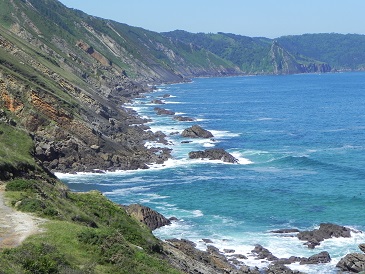
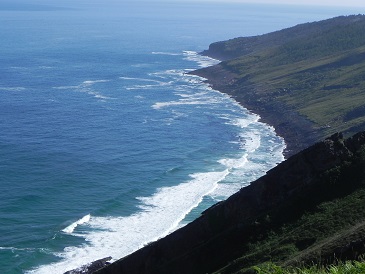
After our return, Martine send me a few pictures from one of her previous hikes on a much nicer day.  She had taken one of the lower trails from the lighthouse in Hondarribia.
Picture
Very rugged by the water
Picture
Looking west on a clear day
Picture
Looking northeast
As you can see, it's a remarkable area.  Most of it is inaccessible except by foot.  We're looking forward to another, longer hike at Jaizkibel starting at the lighthouse.  We'll be exploring many of the lower trails that lead into small protected coves. 

Although Les Trois Couronnes and La Rhune are still the most imposing peaks of the coastal Pays Basque, if you're in the area you should consider a hike at Jaizkibel too.
2 Comments

A Brief Trip up the West Coast of France - Quiberon

6/16/2015

0 Comments

 
PictureQuiberon in Bretagne (Brittany)
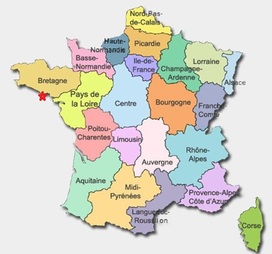
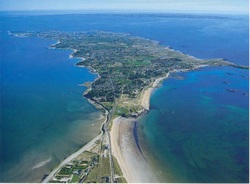
After our stops at Ile d'Oloron and Olonne-Sur-Mer, we finally reached our much anticipated Brittany.  We started with the Presqu'Ile de Quiberon.  'Presque' is the French word for 'almost', so the name literally means the almost island of Quiberon.  And it is an almost-island.  Quiberon is divided into two parts, Saint-Pierre-Quiberon and Presqu'ile de Quiberon.  The latter is separated from the mainland by a sliver-thin peninsula that is only about 70 feet wide.  Driving over this narrow stretch, it's hard to believe that with the radical tide changes in the area, the road isn't sometimes underwater making the Presqu'ile, a true island.   Still, the Presqu'ile feels like an island. 

PicturePresqu'Ile de Quiberon looking south
As you can see from the satellite photo I borrowed from the Quiberon tourism website, it's about as close to an island as you can get.  With an area of less than 9 square kilometers (less than 3.5 square miles), you can walk around the entire  presqu'ile in about 4 hours on the sentier littoral which is part of the Grand Randonnee (GR) 34.  The differences you'll see are amazing.  On the mainland side, you'll find miles of sand dunes like we've seen along most of the west coast of France.  Not far down the west side is the Cote Sauvage,  a rugged rocky coastline with just a few small beaches.  As you enter the main part of the village of Quiberon near the end of the island, you find small harbors and points which block the swells from the rest of the island, and as you round the east and northeast side of the island, you find long stretches of pristine beaches and harbors with calm crystal clear water reminiscent of the Caribbean. 

PictureKaren on the Cote Sauvage at sunset
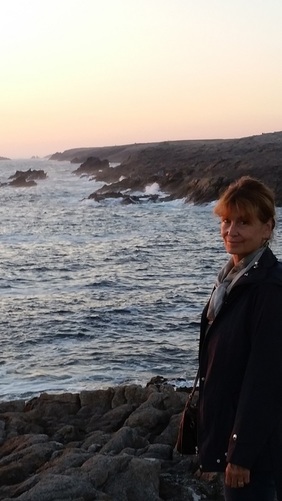
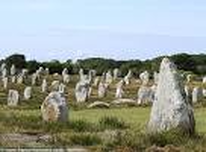
Karen and I arrived in Quiberon mid-afternoon.  We were a couple hours early for our hotel check in but the staff was kind enough to show us to our spectacular ocean-view room.  They also recommended a restaurant called Les Viviers on the Cote Sauvage.    We drove over to the restaurant that stands alone on the cliffs, parked, and started walking the trail that runs along the cliffs for several miles, passing Menhirs, giant stones that date from about 5,000 BC.  At one point we saw a ruined chapel on the edge of the cliff and not far away was a section that was cordoned off.  It was an archeological site, a six thousand year old tomb. A sign indicated that most of the contents had been moved to the Prehistory Museum in Carnac, a few miles away. 

We had a superb dinner at Les Viviers, consisting of broiled clams as an appetizer, mussels for a main course, and very nice Muscadet from the Loire Valley.  Karen and I are mussel fans and these were the biggest mussels we've ever eaten.  It's not the shells that were unusual, it was hard to believe the meat fit inside the shells.  We walked a few more miles after dinner enjoying the memorable sunset.

Picture
View from our hotel room
Picture
One of many Menhirs along the coast
Picture
Sunset on the Cote Sauvage of Quiberon
The next morning we got up at first light and raced to Port Blanc on the Cote Sauvage to find some surf.  After a two hour session, we returned to the hotel for breakfast and then walked around the tip of the island to the east and north.  The points were lined with Cypress trees, and much of that part of the coast looked like Monterey and Pacific Grove.  As we went further east, we passed old forts and encountered new harbors and long stretches of those beaches I mentioned.  It was hard to believe how clear the water was - this was the North Atlantic Coast!
Picture
High tide and onshore in the afternoon
Picture
Heading east on the Sentier Littoral
Picture
Small harbor and clear water - northeast
We were a bit reluctant to leave Quiberon and wanted to explore more but decided to make a stop at Carnac a few miles onto the mainland to have lunch and to check out the museum and the local Menhirs.  Karen and I are not big museum people but the Prehistory Museum in Carnac was fascinating, probably because it represented local history and prehistory starting 450,000 years ago.  In addition to the finds, it chronicled the changes in the land mass, the effects of the ice age  (which at one point froze the English Channel), and showed on maps where to go to see the original sites.  It explained the construction of the Dolmens, tombs dating back to 5,000 BC, and how the massive stones were placed on top - they filled the area with dirt, dragged the stones onto the dirt and then removed the dirt.  It also proposed numerous theories for the more than 4000 menhirs in the area and their unusual alignments. 
Picture
Dolmen near Carnac
Picture
Menhirs a few minutes from the Museum
We left the museum and had a leisurely drive to our next stop, Finistere - land's end (or world's end) depending on your interpretation.  That is where we got a sense of how rugged Brittany can be.  Quiberon, even with its remarkable coastline was tame in comparison to what we'd see next. 

There's no question we'll be back to visit Quiberon and the surrounding area.  Between the beaches, the history, the great food and the surf, it's a place we want to take more time to explore.
0 Comments

A Brief Trip up the West Coast of France - Olonne-sur-mer

6/12/2015

1 Comment

 
PictureOlonne-sur-mer
The real target of our trip was Brittany so after the Ile d'Oleron, we picked a point about half way: Olonne-sur-mer.  I knew there was surf in the area, and from the photos and the bit of research I did, the place looked interesting. 

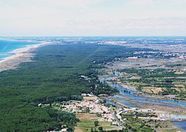
There are miles of beaches ranging from very rugged rocky areas to large sand dunes.  Just inland from the ocean is a forest, which Napoleon had planted to protect the inland areas from the sand blowing off the coast, and just a bit further inland from the forest are marshes which are stops for migrating birds and home to many exotic orchids.

The forest and the marshes are crisscrossed by almost 75  kilometers (~45 miles) of biking/hiking trails and kayaks and canoes are available for exploring the marshes. 

The area has a remarkable history dating back 2500 years.  The Romans occupied it because of its prosperous port.  England owned it beginning in the 9th century and Richard the Lionhearted considered it his favorite hunting area in France.  

PictureView of Olonne-sur-mer
Olonne-sur-mer is a community of about 14,000 people, just 5 minutes from the city of Les Sable d'Olonne.  Contrary to its name, Les Sable d'Olonne doesn't have much sand and the city is trying to find ways to save its main beach.  There's some discussion about unifying the two communities.


We arrived at the Logis Des Maraichers Monday night after a 5 hour drive that was supposed to be half that.  Philip greeted us and showed us to our room.  The Logis has 4 very elegant rooms in a closed courtyard with an outside dining area (for breakfast), and a swimming pool.  Philip then invited us to the office where he showed us maps of the area, indicated surfing spots, and made some restaurant recommendations.  He thought most would be open since it was a holiday. 

Unfortunately, his first recommendation was closed so we chose another on his list - touted for great seafood.   I'd have to say that although the service was excellent, the food was mediocre. 
  

Main beach Les Sables d'Olonne summer
Chateau St. Clair
Ancient Menhirs
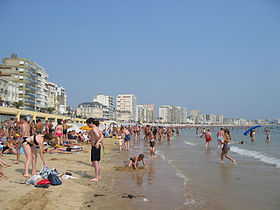
After dinner we drove around the city.  Although there is much history in the area, it seems a bit hard to find or perhaps just incongruous with the city itself.  The Chateau St. Clair which houses a museum and has a lighthouse on its tower is interesting as are the Menhirs - standing stones that may date from 9000 years ago.  But as evidenced by the photo of the main beach which I borrowed from the city's tourism site, it seems like the city is trying to take on a very modern Riviera-like look at the expense of its history.  It probably doesn't help that during World War II, as the Germans were retreating, they destroyed the port, mined the beaches, and wiped out much of the city.   

There's a nice port, but a lot of industrialization in it.  The city doesn't have much charm.  We tried to find some cohesiveness but couldn't.  Some buildings were very new.  Others probably dated from the late 1940s.  But we didn't find much that was fascinating.  Maybe we just didn't know where to look, but in  most French towns and cities, you get a feel for them right away.    Overall, Karen and I agreed that Les Sables d'Olonne felt pretty disjoint - a city trying to find its identity.  Philip, our host at the Logis, agreed.  He's British and came here several years ago in search of an opportunity near the coast.  He seems to have found it in Orlonne-sur-mer, just a few miles north of the city, as the area is popular with the British and with people from the low countries who love the biking trails.  

Picture
Rocky coastline of the Cote Sauvauge
Picture
Sand dunes south of Sauveterre
Picture
Reef and points north of Sauveterre
We got up at first light the next morning and went to one of the prime surf spots called Sauveterre.  It's also a naturist beach, though on that day, it was a bit chilly.  The surf was too small to be of interest, but with miles of sand dunes to the south and reefs from there northward, I could see the potential. 

Giving up on surf, we decided to go for a hike through the Foret d'Olonne.  Like many of the forests that Napoleon had planted along the coast, it was composed of pines growing in sand or sandy soil.  We had a nice walk, but there wasn't anything really remarkable there.

Apparently it wasn't the best time of year for bird viewing so we didn't bring our kayaks and didn't take the time to rent some to explore the marshes.  Since the area didn't excite us too much, we were anxious to move on to Brittany and our next stop, Quiberon.
1 Comment

France : Disc Golf/Hiking Itxassou, Mondarrain, Pas de Roland

6/6/2015

0 Comments

 
PictureBasket is beyond the tunnel - a bad place to miss!
It sounded like a great plan.  Pascal, one of the members of the Disc Golf Sud Landes (DGSL) club had moved to the small Basque village of Itxassou in the Pyrenees about 20 minutes inland from the coast.  He said that he'd found an area that might be great for disc golf on the slopes of Mondarrain.   Mount Mondarrain is a peak that rises about 2400 feet above the Nive river which runs through Itxassou.  Franck, one of the officers of the club suggested we give it a try today and if all went well, he would negotiate with the community of Itxassou to enable us to play there on a regular basis. 

The weather was supposed to be cloudy and moderately cool (about 70), a perfect day for some exploring in the Pyrenees.   It was a great plan.

And then it wasn't.  As promised, Franck, Martine, Karen, and I arrived at the Mairie in Itxassou at 9am to meet Pascal.  Unfortunately, he'd been called away at a work emergency and was unreachable.  We had no maps, no plan, so we asked at the Mairie.  They told us there was  absolutely no parking on the mountain (you would be towed to Bayonne some 15 miles away)and that we'd have to park in the village and hike up.  They gave us a few trail maps, and told us to park near the Fronton, so off we went.

We found the parking at the Fronton, but the maps didn't seem to correspond.  Karen entered Mondarrain into Google Maps on the new phone that she loves and we started following that to the south.  We followed the paved road for a mile or so then found a dirt trail leading up the mountain.  I say dirt, but it was mud.  We started climbing. 

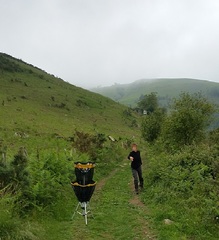
PictureFranck carrying the basket, Martine with lunch
Of course we were carrying our lunches, our disc golf bags, and the disc golf basket.  Ironically, the basket was the lightest piece.  It probably weighs 5 pounds.  Franck loaded up his disc golf bag with some of our lunch and put the basket on top.  Martine decided to load up with the rest in her backpack.

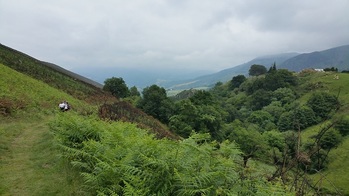
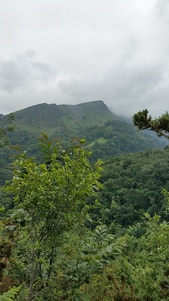
After climbing a few hundred vertical feet in mud, we ultimately found what appeared to be a main trail and took that.  The walk became easier, but it was still a steep steady climb.  Most of the trail was through the forest but we had a few spectacular views of the valley below.  While the weather was ideal for hiking, the pictures aren't terribly impressive on this very cloudy day.

Two hours into the hike and about two thirds of the way up the peak, we were getting tired and hungry.  We finally encountered an open area where we stopped for lunch and a bit of disc golf. 

Picture
View from the trail up
Picture
Karen made this putt!
Picture
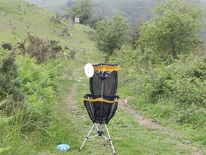
Hanging disc...

These baskets are a bit unusual.  They stand up without falling even with the hardest throw and as I mentioned, are incredibly light.  We've been playing with them for a couple of years here in Southwest France.  They're ideal for disc golf hiking - you can carry the basket and play disc golf wherever you want while hiking.  However, this is the first time I've seen, and according to Franck the first time he's seen, a disc hung up on a 'corner' of the basket.  I assume it's a miss, similar to landing on top of the basket, though my putt followed and Martine's hanging disc fell right in.  We'll have to ask Jack Trageser, from PlayDiscGolf  what to do about a disc hanging on the basket. 
PictureDescending the canyon towards Pas de Roland

After our break, it's fair to admit that we weren't terribly happy with our experience so far.  It had been a challenging hike and we'd found few (no) open spaces for disc golf.  We'd been on a trail with barbed wire fences on both sides.  We decided to give up on Mondarrain.  Looking at a map the Mairie had given us, we saw what looked like a park area around a place called Pas de Roland.  According to Google Maps, it was about an hour's walk. 

We retraced our steps continuing past our muddy trail, and encountered a small paved road.  We headed up the mountain on that road and about a quarter mile later found a spot on the side of the road where a few cars were parked.  Clearly, this was the parking area for Mondarrain with marked trails leading from it up the mountain.  Upon our return, I checked one of the hiking sites in the area and confirmed that this was the place to park if you want to explore Mondarrain without a very long hike.  And, it appears that about half way up from there (a 10 to 15 minute walk), we might have found several places that might have been good for disc golf.  Of course we didn't know that at the time so we continued onward towards Pas de Roland.  A local farmer assured us we were on the right track and a few hundred yards later we turned off the road onto a beautiful trail that descended gently down the side of a canyon with running water below.

Picture
Peaks across the canyon
Picture
Abandoned bergerie


PictureDigitalis stalks
We continued downward passing stands of the strikingly beautiful but deadly digitalis stalks.  These bordered most of the trails both up and down the mountain.

Karen's Google Maps was accurate and we arrived at Pas de Roland in about an hour.  This part of the Nive river is spectacular with grizzled rock outcroppings, white water rapids, and small cascades.  Karen and I have done whitewater kayaking on this technical class 3 river a few miles above Itxassou, but this spot looked particularly inviting with more pools and drops reminiscent of a California river. 

Picture
Basket at Pas de Roland

Picture
Karen with a great putt!
Picture
Calm stretch on the Nive
Picture
We tossed some discs and made our way back into Itxassou, a 15 minute walk.   As we entered the village, we discovered that there were several parking areas with well-marked trails leading up to Mondarrain as well as several other nearby peaks.  We'd added several miles to our search, not only in believing the woman at the Mairie who told us there was no parking on the mountain, but also in following her directions for parking in Itxassou.  We could have had a much more enjoyable hike if we'd never gone to the Fronton.

I can't help thinking that the woman at the Mairie misled us on purpose.  Perhaps disc golf won't be welcome in Itxassou.  Still, Itxassou is a great place to hike.  The trails are beautiful and well-marked - if you start in the right place!

 In all, we covered just over 8 miles and unfortunately didn't get to play much disc golf.  However, we're resolved that at our next opportunity, Pascal will show us where we could have played.  Only this time, he's going to carry the basket and all our bags!

0 Comments

A Brief Trip up the West Coast of France - Ile d'Oleron

6/3/2015

2 Comments

 
PictureIle d'Oleron
Now that we're finally both retired, when we're in France, we're no longer tied to a computer, multiple phone calls daily, and remote troubleshooting and support.  We can  travel outside our local region to explore other parts of France and Europe.   

We've seen much of the Aquitaine coast from the Spanish border up to Bordeaux.  From Bayonne southward, the coastline is rocky with points, reefs, and occasional beaches just below the Pyrenees.  You can read about some of our coastal hikes there in my other blog posts in the France Category. 

From Bayonne north, once you cross the Adour river, there are hundreds of miles of sand dunes reminiscent of those you see south of Santa Cruz on the Monterey Bay.  These dunes, like most of the coastline of France, are protected with beach access limited to designated passes through the dunes.  

We were curious about the west coast of France north of Aquitaine so we decided to take a quick look at several areas to see where we'd want to return for longer visits.  On the agenda were Ile d'Oleron, Les Sables d'Olonne, Quiberon, Finistere, and Perros-Guirec.  The last three are in Brittany.   I'll be doing posts on each one of these places.  The first stop was Ile d'Oleron.

PictureCestas Disc Golf
Our trip started with a disc golf tournament at Cestas, just south of Bordeaux in the Aquitaine region about two hours north of our place in the Pays Basque.   The tournament ended a bit after 5pm (Karen finished in second place for the women), and our GPS indicated a 2.5 hour drive to the Ile d'Oleron.

It was the 24th of May, and we were reminded by our teammates that it was a holiday weekend - Monday was the Pentacote, a national holiday.  We should be prepared for traffic and crowds.


Picture
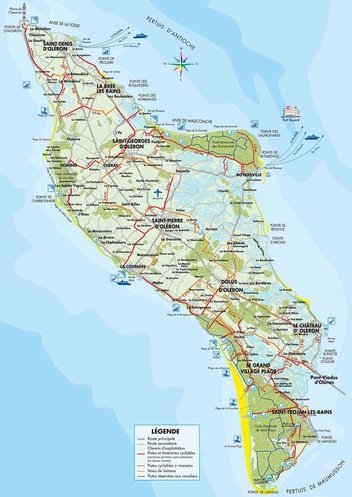
The Ile d'Oleron is the second largest French Island, though the largest, Corsica, is 50 times larger, so Ile d'Oleron's size is not a claim to fame.  It's about 20 miles long by 5 miles wide.  There are many islands off the west coast of France that are almost as large.

The off season population of the island is about 20,000, but that swells tremendously during the summer, particularly in August.  

It's connected to the mainland by a 2-mile long toll-free bridge.  You can drive most everywhere on the island in 15-20 minutes, but if you have the time, I'd highly recommend exploring it by bicycle.   From what we could see, most of the hotels provide bicycles.   There wasn't much traffic on the roads, so they appeared to be safe for riding, but even better, there are over 75 miles of bike paths.  

We were pleasantly surprised that we encountered no traffic getting to the island.  We easily found our hotel in La Cotiniere, a small village on the west side of the island and after a quick shower, walked the quarter mile into the heart of the village where we looked for a restaurant for dinner.  La Cotiniere has a port that is well-known for its catches and the restaurants all have fresh fish and shellfish daily.  After looking at menus, we walked into the Assiette du Capitaine.  There appeared to be only one available table outside (where it was quite cold), and one set for 4 inside which was clearly reserved.  After a brief discussion, the owner decided to give us the 4-top inside since whoever reserved it had not shown up. 


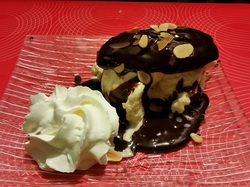
PictureProfiteroles at Assiette du Capitaine
In France, you come to appreciate fine food.  Presentation is always exceptional and the flavors sublime.  But, I must admit that after an extended period here, I do miss spicy food.  And there's spicy-hot and spicy-complex - it's hard to find either in France.  To our surprise, the Assiette du Capitaine served fresh fish with exotic spices from the Carribean and South America.  All of their food is organic and made onsite, and the fish is fresh caught that day. Although we had several superb meals on our trip up the coast (you'll hear more in subsequent posts), without a doubt this was the best meal we had on this particular trip.  We should probably have taken pictures of our appetizers and main courses, but we were hungry, and even the best photos can't do justice to the subtlety of flavors the chef created.  Instead, here's a picture of the best profiteroles I've ever had.

Since Monday was a holiday, we knew we had to leave by mid-afternoon if we wanted to avoid the traffic across the bridge back to the mainland, so we got up early and began exploring the island. 

On the southeast corner is Le Chateau d'Oleron and its Citadel which was built in the 17th century.  If you're an oyster fan, you can take the Route des Huitres northwest by bicycle or car and do oyster tastings along the way.  According to the most of the French we've met, the oysters from the Ile d'Oleron are the best in France.    The coastline is rocky and rough with a few small beaches.


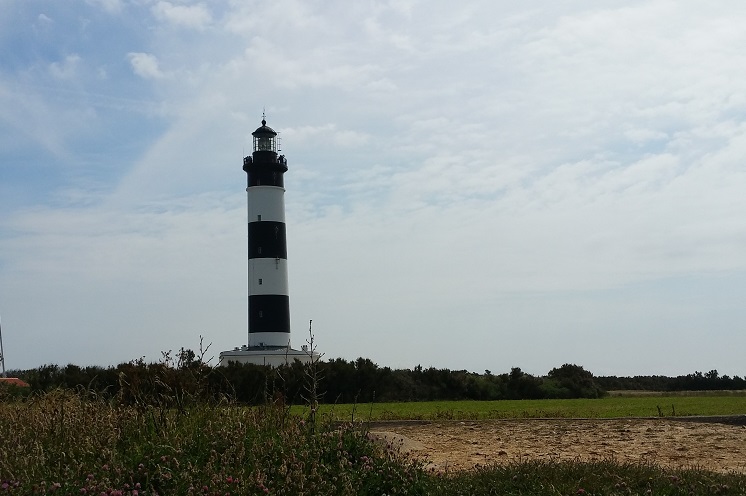
Continuing up the coast you will pass through the village of Saint Denis before arriving at the black and white stripped Phare de Chassiron lighthouse.  If you like lighthouses, there are at least 6 significant ones on the island including 3 in Chateau d'Oleron and one in La Continiere. 

The Phare de Chassiron lighthouse is open to visitors and you can see the entire island from the top of the 151' structure.   The original structure was built in 1655 but it's seen a number of renovations/enhancements since.  These are described in detail on signs as you enter the lighthouse grounds.

The lighthouse is surrounded by a garden which includes explanations of the wind patterns and their legends, memorials to shipwreck victims, and numerous sculptures.    Shipwrecks seem to be a major theme of the coast north of Aquitane. 

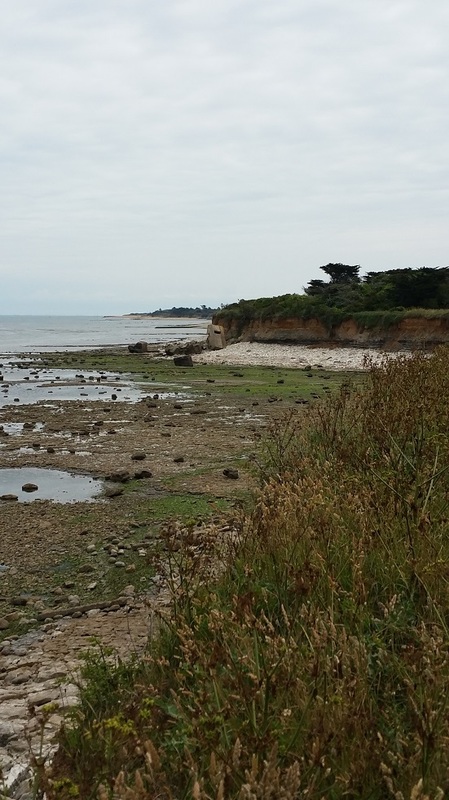
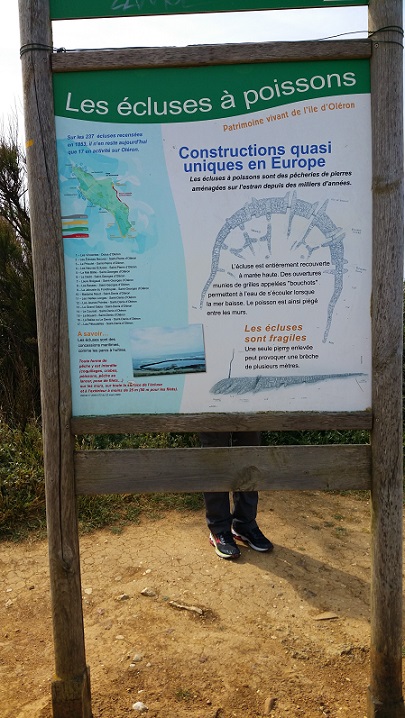
There are trails leading west and south from the lighthouse that extend for miles.  The coastline is all rocky reefs and points with ecusses - former large scale fishing traps - structures build of stone with netting or grills in various places.  At high tide, the water would spill over the top of the walls and at lower tide would run out through the grills/nets trapping the fish.  This type of fishing is now outlawed, but the structures still stand in the reefs.

There is good surfing here at the end of the island, but as one local said, don't go out alone and be very aware of the tides or you'll find yourself dragged all the way to La Rochelle 15 miles away. 
Phare de Chassiron
Reefs, points, and ecusses near Chassiron
Explanation of how ecusses work
PictureSand dunes and pine forests on the west coast.

As you head west and south, the rocks and reefs give way to sandy beaches near La Hutte, a well-known surf spot.  From there onwards along the west coast of the island, it's miles of sand dunes, often bordered by pine forests.  Like the rest of the French coast, the dunes are protected, but there are plenty of passages to the beach.

We spoke with several people about the island, tourism, crowds, etc., and indeed, during late July and August, there are continuous traffic jams on the island.  Much of the island is now home to camping parks and these fill up quickly.  But, just a bit off-season, there are very few people, and empty beaches, roads, and bike trails.  Even during our holiday weekend, it seemed pretty deserted. 

PictureFort Boyard
We were a little pressed for time since we hoped to avoid the holiday traffic leaving the island so we cut our visit short.  If we'd had more time, we probably would have explored by bicycle instead of car and we would have taken a couple of days to do that.  We would have spent time in Chateau d'Oleron and probably would have taken the boat trip to Fort Boyard, a strange looking fortress in the channel separating the island from the mainland.  We would have visited the Port des Salines to learn about salt production.  And, we would have sampled more restaurants.

We left the island mid-afternoon, but in spite of our early departure, spent a long time on the bridge to the mainland and even more getting through La Rochelle (there was a huge flea market that had roads backed up for miles).  Our projected 2.5 hour trip to Sables d'Olonne (my next blog post), took nearly double that.

Would we go back to Ile d'Oleron?  Yes, but it would be off season - May/June or late September/early October.    The food was memorable and since our return, I've heard from others that the Ile d'Oleron has some of the best seafood in France.  And, I must admit that I'd like to see if I can find some uncrowded off-season surf there.

2 Comments

Are You Really Ready for Retirement?

5/20/2015

9 Comments

 
PictureAre you ready for this?
This is not a post about whether you're financially ready for retirement.  There are plenty of tools available to help you decide if you have enough money to retire.  No, this is a post about whether you're emotionally ready for retirement.  You may think so, but the reality may be harsher than you think!
What got me going on this subject is Karen's retirement.  After spending her entire life as an accountant, Karen retired a few weeks ago.  We're now in France enjoying our first trip where neither of us has to work.  No more working while everyone at home slept, then working again when they got to the office during our evening time.  No more working more hours here that we did at home.  This time we can be really retired: we can travel and play as much as we want - that's what everyone works for, right?

Well, probably.  I'm seeing Karen go through many of the same ups and downs that I did when I started my 'retirement' three years ago.   It certainly wasn't anything I was willing to admit to at the time, but it was harder than I thought.  I claimed to not be retiring,  to be making a career transition into writing.  And while that's somewhat true, the reality is I was a technologist and entrepreneur.  I'd done that all my life.  Like most Americans, it didn't just define what I did, it defined who I was.  I must have had some thoughts of going back as is evidenced in my post Am I Done? 

In looking around at my friends, I've discovered that very few have been successful at retirement.  After six months to a year, they're back at it.  Most say they were bored.  Many say they missed the excitement.  Even more missed the social interaction that work brings.  And I'm not just talking about people in high tech.  Two lawyer friends were back at it within a year.  A chef didn't even make it six months.  Two friends in construction drove their wives crazy with projects around the house and were pushed back into building for others.  Every doctor I know has gone back to work, at least part time. 

Several more friends say they'll never retire.  Even though they have more than enough money to live on the rest of their lives, they're not willing to give up the sense of achievement they have in their careers. 

And yet there are some success stories.  A dentist friend is happy travelling and helping others get businesses started.  The former venture capitalist I mentioned in that earlier post seems to be pursuing his extreme sports with even more fervor than before.  And, I guess I'd have to say that I'm happy with my retirement.  Writing, surfing, and pursuing my other sports is actually enough for me.  Now, with Karen retired, we'll be doing a lot more travelling too.

But I did go through an adjustment, a big one.  And although people claim that it's the boredom, the lack of excitement, missing the sense of accomplishment or the people, I now believe that the real reason is much more ominous.

Karen and I discussed this in one of her down periods (which have been fewer and fewer).  When you've worked your whole life with the goal of retirement and you finally have the financial resources to get there, when the business and personal timing is right, you step out and you move into a different phase of your life. 

The title of that earlier post was more perceptive than I thought - Am I DONE? 

Being DONE is depressing.  You've worked to accomplish something.  And now it's over. It's not just the letdown because retirement doesn't meet your expectations, it's that fear that you're entering the LAST stage of your life.  Are you really ready to be DONE? 

I think this is what drives people back to work.  They look around and fear that they are done.  They're not ready to be in the LAST stage of their lives.  I admit it, I had the same fear and Karen does too. 

Maybe this is obvious to you.  But until that LAST stage is staring you in the face, you probably won't really understand how difficult it is to walk away from what you know, from what you've done, and perhaps from who you've been your whole life.

So what's the key to retirement? 

Don't be done.  

Retirement is not just a time to relax.  Sure, take a few months to catch up on your sleep, to revel in not having to be anywhere or do anything on a schedule.  Lose track of the day of the week.  But don't extend it too long.  It will get scary.  You'll find yourself on the slippery slope towards the end of your life.

 Instead, make plans, stay active, continue to make a difference in the world.  Maybe you have to go back to work to do this, but I've learned that I don't and from what I can see, Karen won't need to go back either. 

We've made plans: more sports, more dancing, travel, mentoring new business owners, getting more involved in good causes, we have a long list.  With very few financial worries and with  kids driving forward in their own successful careers, our newfound freedom guarantees that this  new phase of life is going to be the most exciting yet.

9 Comments

Disc Golf?!!
3/17/2015

0 Comments

 
PictureA birdie shot through the trees at DeLaveaga.
A little over three years ago, Karen asked me to join her in her new sport, disc golf.  I laughed.  After all, I'm a surfer, skier, hang glider pilot, whitewater kayaker - a risk sport person.  Why would I ever want to do something like disc golf?  Worse, while I'd thrown a Frisbee a few times decades ago, I was terrible at it compared to my friends in college who did all sorts of trick throws on the beach while I was out surfing.   I couldn't imagine that this was something I would ever want to do. 

But Karen's son Victor had introduced her to the game/sport and she really seemed to like it, so I reluctantly agreed to give it a try.  She gave me a Valkyrie driver disc and a putter and off we went.  As expected, I was terrible. 

We started at DeLaveaga which is a world-renown championship course - probably way out of our league.  But we stuck with it, playing most days after work for an hour or two.  Somewhere along the line, we played the courses at Black Mouse, in the spectacular redwoods of Felton, and at Kirkwood, in the Sierra, where you work your way up, then down the mountain, throwing around gigantic spruce trees, over rugged lava rocks, while hiking through fields of wildflowers.   The beauty of these courses convinced me that disc golf is a reason to go hiking - most of the courses are in semi-remote areas and it can be a decent workout to play them.  Plus, you're looking at natural scenery, trees, creeks, birds, animals.  It's certainly a lot more environmentally friendly and interesting than ball golf. 

So here I am, three years later and I play disc golf two to three times a week.  If the surf is blown out or too small, I play disc golf instead.  With the return of daylight savings time, Karen and I now play after work.  If we're travelling to the mountains, we stop somewhere and play a round.  If we're driving anywhere or are overseas, we're always looking for a new course to play.  On weekends or holidays with the family, invariably, disc golf becomes part of our visits.  I wouldn't say I was obsessed, but at the same time, I have to admit to more than just a passive interest. 

I guess I'm also an evangelist.  When a friend's husband had a heart attack in his 40s, I suggested disc golf as a way to begin exercising.  Unlike me, he was a natural and the two of them now play regularly.  A business associate complained that her husband was getting a bit sedentary.  I proposed disc golf, and now he plays whenever he can.  In those two cases, both individuals lost weight and got into much better shape.  A couple hours of hiking and throwing a few times a week can do the trick.  And, because it's fun and you can usually bring your dog(s), it's easier to get motivated to play disc golf than to go the gym to work out. 

In France, we discovered and joined a local disc golf club, then introduced several people to the sport and the club.  They, in turn, introduced several others and we're seeing a rapidly growing family sport in the region.  Check out our first tournament experiences in France in my post Disc Golf France - Coutras Tournament.

So, have I gotten better after my dismal start?

Well, over the first eighteen months, I'd have to say there was improvement, but in reality, my drives and approach shots were, to put it nicely, inconsistent.  Others might have called them wild.  If we played with Karen's son Victor, he slaughtered me.  Of course he's a natural athlete and 20+ years younger, so I had a good excuse.  Then he gave me disc golf lessons for a birthday present.

Was I insulted?  After all, I'd never taken a surf lesson or a ski lesson or a trail running lesson.  Sure, I'd taken hang gliding and kayaking lessons, but that was just for the basics.  I was beyond the basics in disc golf, right? 

After putting it off for a few months, I finally contacted Jack Trageser to take my lesson.  Jack is a professional disc golf player and owner of School of Disc Golf, now part of Play Disc Golf, Jack's new startup dedicated to growing the sport and giving a voice to the casual and amateur players. 

Jack played a round of disc golf with me, Karen, Victor, and Victor's wife and analyzed my strengths and weaknesses.  I guess there weren't too many strengths.  We pretty much started from scratch in our first actual lesson where he showed me how to throw properly and took videos to track my progress.  My next lesson was even more informative - approach techniques, and, perhaps more important, analysis and strategy - the mental part of the game.

And so, I started playing and practicing.  We have a small park not far from the house which has a few practice baskets.  I worked on my  technique religiously.  Within a few weeks, I surprised Victor.  I beat him.  In fact, for a short period, I beat him consistently.  And then I made a big mistake.  I bought Victor a lesson pack with Jack and School of Disc Golf.

Okay, it really wasn't a mistake.  In fact, Victor and I trade off victories pretty evenly these days.  We work together to coach each other and we're getting to be pretty decent.  I don't see us on the Pro tour anytime soon, but we'll definitely be playing in upcoming tournaments and club leagues.  Don't tell Victor, but I will be taking more lessons with Jack.  

Jack has great vision and plans to bring disc golf into the mainstream.  With his remarkable marketing skills and irrepressible energy, I can only see success ahead. 

If you haven't tried disc golf, you should.  There are thousands of courses in the US and abroad.  Most are in beautiful locations and the game gives you a reason to explore places you might never have ventured into.  Plus, you'd be surprised at the people you meet and their enthusiasm for the sport.  I'm used to surfing.  I'd never want a new surfer to join the lineup.  In disc golf, it's exactly the opposite.  People love to promote the sport and to help us newbies. 

Get out there!  Take a lesson!  And support the sport through Play Disc Golf!
0 Comments

Should Your #Startup Try #Crowdfunding?

2/18/2015

0 Comments

 
  • A few surfer friends came up with a great idea for a product and used Kickstarter to raise funds.  Their campaign was overfunded and they're now on their way to launching their product.
  • A doctor had a great idea for a research project.  He applied for grants but the process was long, so he used crowdfunding to bridge him to the grants.
  • A filmmaker used crowdfunding to pay for her short film.
  • An author friend actually raised substantial money for travel as part of the research for his next novel.
Picture
About a year ago in one of my #startup posts, I briefly discussed crowdfunding.  For the most part, I was negative on the idea. 

Now, a year later, I've seen some Crowdfunding successes and I thought the subject might be worth revisiting:

And of course there are hundreds of anecdotes about successful crowdfunding projects - just search the web.  Or, better yet, take a look at How to Run a Kick-Butt Kickstarter Campaign.  While focused exclusively on Kickstarter, this presentation provides excellent information not only on how to run a crowdfunding campaign, but statistics on the numbers and types of projects that have succeeded and how much money they have raised.  If you decide to go the crowdfunding route, it's a great place to start.

But should you use crowdfunding for your startup? 

A year ago, I would probably have given a categorical NO.  Today, after seeing so many successes, I'd say it depends on your project.  With the exception of the surfers' project, those I mentioned above really didn't have anything to lose in seeking crowdfunding - they weren't really startups anyway.  I single out the surfer's project because they were building a unique product as the basis for an ongoing business. 

Unfortunately, crowdfunding shows your idea to the competition.  You clearly lose some competitive advantage and risk losing your entire market if a larger player decides to jump in ahead of them.  Thirty years ago, this wouldn't have been a problem in the surfing world, but today, there are some huge companies in the industry.

So that's probably one of my biggest concerns.  If your startup is building a product and you want to preserve some secrecy about it, don't do crowdfunding. 

Okay, so it turns out you don't need secrecy.  Can you use crowdfunding for seed money?  How about offering your investors equity - a piece of your company?  After all, family, friends, and some generous strangers believe in you and your plan.  They're putting down their hard-earned cash to let you chase your dream.  They should have a piece of the action, right?

Here comes that categorical NO. 

In my blog on Angel Funding, I suggested that you didn't want Uncle Jim, who made money selling used cars, telling you how to run your business.  You certainly don't want hundreds or possibly thousands of Uncle Jims not only telling you how to run your business, but having the right to look at everything you're doing. 

With equity funding, you have to disclose your business plan and financials.  These become public and in the world of crowdfunding via the Internet, everyone will be watching you and may want to 'help'.  From the direction the SEC is going, equity in crowdfunding is going to be very complicated and expensive.

Let's just say NO to giving equity to your investors.  

So what do you give investors who help you to raise some seed capital?  First, be sure to limit your crowdfunding to a specific project.  Make sure that your obligations to the investors are well-defined and short-lived.  Be clear that they're investing in a project, not in your business, and that what they receive for their investment is not ongoing.  Give them early samples of a new product, discounts on future products or services, or some kind of recognition award.  

Once your campaign is over, you can then grow your business with no additional baggage - baggage that might encumber your business plan, cause you to lose focus, or make it difficult to bring in qualified investors or partners. 

You can use the money to get your project off the ground and use the project to help bootstrap your company through sales of your new product or service.  You avoid obligations to family and friends or seed investors, and you have a base from which to launch.

So yes, I have revised my opinion on crowdfunding.  I still think bootstrapping and using Angels are the best ways to fund your startup.  But for certain businesses needing help on very specific projects, I think crowdfunding can work. 

#Startup - Can YOU Swing for the Fences?
First Building a Startup Post
Build it or Buy it - Which Should Your #startup do?
0 Comments

 Another Translation Challenge - shaggy dog stories

2/9/2015

0 Comments

 
Picture
As I described a few months ago in my post Translating Your Novel, I'm in process of working with  Peyo Amulet, a French translator, to translate  The Shadow of God  into French .  The translation is going more and more smoothly.  In fact, aside from one significant issue, there were only a handful of very minor translation errors in the latest 50 pages that Peyo sent me for review. 

We seem to have worked out all of the challenges I pointed out in my previous post:

     - Language: Peyo looks for situations and chooses formal/familiar as needed
     - Sentence Structure: Peyo uses popular French so there are more fragments now
     - Culture: we assume a knowledge of American ways and don't try to create equivalents 
     - Elimination and addition of text: this is less of an issue than we thought
     - Rhythm: Peyo seems to have now captured my rhythm

We've also worked on formatting and have both come to understand how dialog is represented in popular French fiction as opposed to classic French fiction.  There's a lot more ambiguity in terms of which words are 'spoken' versus description about the dialog or the person speaking.  For example,  "I tried," he said walking home, "eating raw sushi." becomes - I tried he said walking home eating raw sushi. 

Was he walking home when he tried it or did he say he was trying while he was walking home eating the sushi?  And paragraph usage - in modern French fiction it appears that there's no good way to represent multiple paragraphs in one person's dialog - it's all one paragraph no matter how long.  But as I said, we've worked out all these challenges. 

But now, the culture issue has come back.  I guess this is to be expected, but we thought we'd worked out a strategy to handle cultural differences.  Not this one. 

In The Shadow of God, Jim is a somewhat reclusive character who steps into a family of lawyers and well-connected people who love to share their larger-than-life experiences.  Coming from more humble origins and a being a bit more circumspect, Jim still gains immediate credibility by telling shaggy dog stories.  For those of you who aren't familiar with shaggy dog stories, these are tales that are embellished as much as possible to lead your listeners down the garden path and then to conclude the story with a play-on-words pun.  Many of you are familiar with one that ATT turned into a television commercial some years ago. 

I'll avoid the shaggy dog aspect by keeping it short - I could go on and on about descriptions of the people, the lands surrounding the kingdom, the chases, etc., but I won't.  It's the story of a kingdom besieged by a giant dragon with huge yellow fingers.  Knights try to slay the dragon but the creature scoops them up in his massive yellow fingers and tosses them into his mouth like popcorn.   With all the knights eaten, their squires try to slay the dragon but they, too, are scooped up by the horrible yellow fingers.  After weeks of siege, the kingdom is starving.  A young page volunteers to get past the dragon to reach the sheriff who will bring an army to kill the dragon.  But the king can't see sending a young page to his certain death so he refuses.  Weeks later, people are dying of starvation.  The page volunteers once more and this time the king reluctantly agrees.  The people gather on the parapets of the castle and watch as the little page makes a run for it.  The dragon scoops him up easily and a collective sigh of disappointment and despair runs through the crowd.  They turn away.  But then someone says "Look!" and sure enough, the little page is so small that he has slipped through the yellow fingers.  The page starts to walk and as the fingers come down, he escapes again.  Ultimately, he makes it to the sheriff who indeed does bring the army to slay the dragon and the kingdom is saved.  The moral?  Let your pages do the walking through the yellow fingers.

Now it's possible that this ATT motto - Let your fingers do the walking through the yellow pages - does exist in France.  In fact, page has the same ambiguity - it can be a young trainee for knighthood, and it can be paper in a book.  They do have les pages jaunes (yellow pages), so this one MIGHT work.  Peyo is looking into it.  But I can guarantee my next two shaggy dog stories with their plays on words won't translate.  The expressions don't exist in France and even if they did, the translation of the plays on words definitely won't work.  In one, my play on words is based on glass and grass.  Verre and herbe clearly won't work. 

So what do we do?  One possibility is for Peyo to substitute French shaggy dog stories.  These must exist as the French love les jeux de mots (plays on words). 

The other possibility is that Peyo keeps the existing translations and then adds a footnote for each, explaining the English expression and the juxtaposition of the words to create the play on words in English.  I kind of like this option as it preserves the integrity of my way of telling these stories and of Jim's character.

We many end up with a combination of the two approaches as one of the stories uses such an obscure expression as the base for the play on words, that even with a footnote, it wouldn't make sense to someone who didn't grow up in an English-speaking culture.  That one probably needs to be replaced with a native French story. 

The good news is that with over a third of the book translated, aside from the shaggy dog stories,  I think we've seen all the major  issues we're going to see.  I now go through the upcoming sections of the book in advance and give Peyo warning about possible difficulties so he can move through them prepared.  I did this recently for hang-gliding scenes where I researched the French vocabulary for hang gliding terms and made them available to him.  He was flawless in his application of terms to a sport he'd never experienced.  

So here we are,  more than a third of the way through the text being translated.  We're actually probably more than half-way through the process given all we've had to learn about language, style, and working together.   

I'm having a blast. 

Writers usually work alone.  But, I must admit that it's fun working with someone else.  And, it's incredibly rewarding to see my story reemerge in another language.

I'll post again on this topic if other significant issues arise.  Otherwise, I'll post in a few months when we have feedback from a few of our initial French readers.  Note the 'our' in the last sentence.  If there's one thing I've confirmed in this process, translation, at least in the way we're doing it, is really a joint rewrite.  For the French version, Peyo is my co-author.

0 Comments

#Startup - Can YOU Swing for the Fences?

2/6/2015

1 Comment

 
Picture
Last night I had dinner with an entrepreneur who presented me with the five-year plan for his growing business.  It's a solid plan that builds on his current business, expanding slowly for two years, then growing more rapidly.  I thought it was brilliant because the entire growth path, which might even get him into the IPO league, is self-funded.  He has contingencies for potential future problems and possible missed goals, and from what I can see, it's unlikely that he won't see the success he has laid out so carefully. 

But then he told me about his special project. 

It's true, most of us have them.  After all, we're entrepreneurs.  We're idea people.  We can't help it.  

Unfortunately, we have learned the hard way that these special projects can kill us.  They distract us from the focus we need to be successful.  And as my friend went into more and more detail about the technology, the initial trials, and the size of the market for the product that so intrigued him, I couldn't help but fear for the future of his main business. 

At the same time, I must admit that I, too, was fascinated by the opportunities in his special project.   

He asked me if I thought he could raise venture capital for it.  And of course, I had to ask the question: "Are you prepared to give up your main business to pursue this opportunity?"

With his negative response, I told him that first, I thought this special project was a perfect bootstrap candidate, and second, that if he were to raise VC investment, in addition to giving up a substantial piece for seed/early stage funding, the VCs would demand that he focus on this single opportunity.  That he 'swing for the fences.'  That he drop his main business.

We then kicked around the idea of him hiring someone to take over his existing business while he goes for it with the new one.

In previous posts, I've suggested that 'swinging for the fences' is something you can choose to do at various times in your life/career.  If you're young with no mortgage payments, family, or major obligations, you don't have much to lose.  Or, if your kids have left home, you've got some money in the bank, and some years of experience, again, with little to lose, why not take the chance?

But in thinking about it further, I began to ask myself (and my colleague from last night) if it might be more a question of temperament.  Does he have what it takes to swing for the fences?  As I thought about it, I realized that personally, I really don't have it. 

Some part of me wants to build a sustainable business that guarantees a reliable income for me and my employees, and is pretty much assured of at least moderate success.  I don't want to put them, me, or my brilliant idea/business plan at that much risk. 

Okay.  Maybe I'll never make it really huge, but as I suggested in my post  #Startup - Go Big or Go Home? , it appears that people who build these sustainable, non-VC-backed companies usually do better financially than those who swing for the fences.  So maybe it's not really a character flaw to be a more conservative type of entrepreneur. 

Ultimately after much discussion last night, my entrepreneurial friend admitted that he was like me.  He came from a place where he didn't like a lot of risk.  Clearly, starting any business is a risk, but we want to take as little risk as possible.  We want to be assured of winning every time, even if we don't win as big. 

I concluded with my insurance at blackjack strategy.  I don't gamble much but when I do, I play blackjack.  I admit it, I count cards.  I do whatever I can to turn the odds in my favor.  If you know blackjack, you know that if the dealer has an ace up, s/he will offer you insurance.  You can 'insure' your bet by purchasing insurance which pays 2-1 if the dealer has blackjack.  Statistically, if you have blackjack, the odds of the dealer having blackjack are smaller.  So you shouldn't take insurance if you have blackjack. 

On the other hand, if the dealer actually does have blackjack, you push - a tie.  You don't lose your money, but you don't win either. 

Me, I take insurance if I have blackjack.  Why?  Well, if the dealer doesn't have blackjack, I've paid 50% of my bet for the insurance, but I win 150% for my blackjack, netting me a gain of 100% of my bet.  If the dealer does have blackjack, I push on my bet, but I win 2-1 on my insurance, netting me a gain of 100% on my bet.  In other words, I always win - always. 

In the long run, I may not win as much as I would have if more often than not I'd won 150% of my bet but tied some of the time.  I'm the kind of person that given the choice, would rather never lose and be guaranteed that I'll always win.  I'm just not a swing for the fences kind of guy.  I take insurance  when I have blackjack. 

As we wrapped up the evening, my friend admitted that he's the same.  He's now exploring hiring someone who doesn't take insurance when s/he has blackjack to head up his higher-risk venture.

Negotiating Agreement
Should Your #Startup Try #Crowdfunding?
1 Comment

Negotiating Agreement

1/26/2015

0 Comments

 
Picture
I recently worked with two companies to finalize the purchase of one by another.  Compared to most agreements I've helped develop, this one was probably one of the most painless.  I'll talk about that particular negotiation at the end of this blog. 

First, let me say that I've been a long time fan of Getting to Yes and Getting Past No, two books that came out of the Harvard Negotiation Project.  They espouse a philosophy called Principled Negotiation which attempts to get both sides to negotiate interests instead of positions.  If you haven't read them, I'd suggest picking them up.  They're short, quite approachable, and if you're not already using their techniques in your negotiations, you should be.

I started my career as a somewhat weak negotiator.  Like many, I was very idealistic and believed that ultimately everyone negotiated for a win-win.  I always wanted to be fair and to give the benefit of the doubt to the other side.  And too often, I gave away too much to get the deal done.  This created resentment on my part and I found myself finding ways to terminate these agreements by looking for better partners.  You see, not only had I made a mistake in my weak negotiations, the other side made mistakes by ultimately taking advantage of my weaknesses. 

How did they lose out?  In business, the vast majority of negotiations are intended to create lasting relationships.  If a negotiation concludes and one side is unhappy, there's a good chance problems will arise from the bitterness and resentment caused by the negotiations.

For me, I think I hit a wall when I began my first negotiations with Israelis.  I don't really mean to stereotype, but I think most people will agree that Israelis are tough negotiators.  My first deals were with startup companies who wanted to license our technologies.  Later, I negotiated with larger companies to represent our products.  One of my companies was acquired by an Israeli company and ultimately, I bought that company back.  I learned a lot negotiating with them. 

At first, it just seemed like they constantly pushed to get more.  If anyone was happy, negotiations had to continue.  I left meeting after meeting frustrated.  Every deal was a lose-lose.  If both parties weren't unhappy, clearly one had taken advantage, so both sides had to negotiate until they were equally unhappy.  Only then did you have a good deal.  Several times, I walked out of meetings convinced negotiations were over.  This seemed to make my adversaries happy, or appropriately unhappy, and usually we came to agreement shortly thereafter.  It seemed like a miserable way to start off a new business partnership.

Worse, they seemed to enjoy these negotiations while I just tried to survive them. 

Or maybe I just didn't understand what was going on.  I didn't know how to stand back from the negotiation and look at it objectively.  I didn't know how to separate negotiating positions from real interests.  I didn't know how to step into the other side's shoes and really look at the situation.  And I didn't know how to deal with people who used position, power, and advantage to beat down the other party. 

In reality, it wasn't the Israelis, it was me. 

Fortunately, after one particularly difficult negotiation, my adversary and new partner decided to counsel me.  Completely independently of Getting to Yes, he taught me the techniques and even role-played situations to help me develop my skills.  And I got much better.

Over the years, I also came to realize that most of us think that each deal is critically important.  Too often we'll do whatever it takes to make it happen.   At some point, we begin to focus too much on making the deal, not on why we're negotiating in the first place.   I learned that very few deals are critically important and that it's okay to walk away when you realize that either the other side isn't listening or isn't sensitive to your interests, or that you just don't have enough common interests to benefit both sides.   Having the ability to walk away is a very powerful weapon in your arsenal.  Ultimately, it makes you step back and look at the negotiation objectively, look at the interests of both sides, look at the people involved and what's important to them, and be a better negotiator.

So what about the recent acquisition?

We got lucky.  From the outset, both sides explained exactly what they wanted to get out of the deal.  With agreement on the highest level objectives, it came down to deal points which were all interest-based.  Personalities did not get in the way.  There were disagreements, but with each one, we looked at alternative solutions, the pros and cons of each, and how they affected the goals of each party.  Sometimes there was impasse.  We'd sleep on it and usually, if there was no reasonable compromise found, we'd agree to a tit-for-tat - an exchange to make up for what one party was sacrificing. 

I must admit though that towards the end, contract fatigue set in.   I've seen this happen a lot.  After weeks of negotiations, particularly if there are delays, frequently caused by the advising attorneys, people just want to get it over with.  This is a dangerous time as too often one side will just walk away exhausted. 

It's a time when both parties need to be conscious of the risks to the deal and may need to bring their attorneys into line by assessing real risks in the contract language.  Ultimately, a contract comes down to trust between the parties.  Remember, attorneys are your advisors.  They're not negotiating the deal for you.  You need to manage them and make them understand your needs in closing a deal.

In our case, both attorneys recognized the importance of the timing of the deal and they too focused on the parties' interests.   This time we survived contract fatigue.

All-in-all, it took about six weeks to finalize and sign the purchase agreement.  Both sides are excited about moving forward.  Both sides feel they got everything they needed out of the deal and both sides came away with a better understanding of the goals of the other. 

I see promising outcomes for both.

Selling/Purchasing a #startup - Assets or Shares?
#Startup - Can YOU Swing for the Fences
0 Comments

Our #EV (Electric Vehicle) Pros and Cons

1/13/2015

1 Comment

 
PictureTelsa Model S in the snow?
We could have bought a Telsa but decided not to.  Was it a good decision? 

A little over a year ago, Karen's faithful Subaru was on its last legs.  She didn't want to give it up but the reality of the increasingly expensive repairs made us decide to buy a new car.   With my recent 'retirement', I drove up the coast in search of surf most days, while Karen had to get to work and to client sites.  Until Karen retires, we need two cars. 

I had recently bought my long sought-after Audi AllRoad.   Since the Audi provided everything we needed for long distance driving (we make regular trips to the Sierra to ski when there's snow or whitewater, and periodic trips to Oregon to visit Karen's daughter), we decided to consider electric vehicles for the second car.  I did the research.

Clearly, the gold standard was the Tesla model S.  It promised a range of 265 miles, an option for fast charging, a  network of free charging stations, and it was a nice looking car for a sedan.  Our friends who owned them loved them.  But at $90,000 in the configuration we would have chosen, it was worth considering other options.

In fact, it made us much more realistic in assessing our driving needs.  Did we really need a range of 265 miles?   My daily rides up the coast were much shorter (though sometimes my surf driving took as long as driving 265 miles), and Karen's commute downtown and trips to clients in the Monterey Bay Area or occasionally over the hill, were nowhere near 265 miles. 

And as we thought about our longer trips, considering the possibility of replacing the Audi, most were to the mountains where there were few charging stations, and at least for 5 months of the year, we often encountered snow.  We weren't prepared to give up the all-wheel drive of the Audi.  Tesla has since announced the all-wheel drive model D, but there are issues with taking that to the snow as well (more on that later). 

And the final nails in the Tesla coffin were that it seemed to be a 'status' car and that I would likely be parking it on the side of Highway 1 when I went surfing.  It just didn't fit the surfing image  and did I really want to leave a $90,000 car parked in some of these places?

So if we ruled out the Telsa, what were our other choices?   We quickly determined that the vast majority, at least 90% of our driving, required trips of less than 60 miles.  And, it turned out that virtually every electric car had a range beyond that distance.  So, I started looking.  A couple of my friends had Nissan Leafs.   They were satisfied with them but not excited.  And at that time, the Leaf's range was surpassed by other, less expensive vehicles.  

I worried about a number of vehicles like the Honda Fit and the Toyota Rav4 EV because it seemed like the manufacturers were just providing these vehicles to meet California zero emission requirements.  I talked with two Rav 4 owners and learned that they were quite happy with the range (over 100 miles), but that they were unhappy with the charging time and the amount of energy required to drive short distances.  The Rav4 was a standard Rav4 with a Tesla battery.  There were rumors of issues between Toyota and Tesla too. 

The Fit was only available on a lease basis which after watching Who Killed  the Electric Car (and personally seeing the experience of one of its owners when GM demanded it back - and he refused), that seemed risky too. 

PictureFord Focus Electric
So ultimately, after looking at several different vehicles, we ended up buying a Ford Focus Electric.  I must admit that this is the first American car I've ever owned and after 14 months of ownership, I couldn't be happier.   Of course, we had a lot to learn. 

The Focus came loaded with every option my Audi has and more - heated leather seats, GPS, multimedia, web access, back up camera, proximity sensors, everything.  Its EPA range was 78 miles - certainly more than we normally drive.  And with Federal and State rebates, I believe it was $22,000 out the door - we could have bought 4 of these for one Tesla.  We decided to lease the car because our driving distances fit within the lease parameters and because we expected that battery technologies would change in the next three years, making the older models effectively obsolete.

Because of circumstances I won't go into, we ended up buying the car in Walnut Creek.  I asked the dealer about the range, telling them that with the Audi, I get much better mileage than the EPA numbers.  Would this translate into a greater range for the Focus?  They assured me that it would (they were wrong).  The GPS told us it was 79 miles to our house in Santa Cruz, so the Focus should make it, right? 

Well, not really.  We stopped in San Jose for dinner after finding a charging station (and figuring out how to use it without a Chargepoint card - another story) to give the car a bump.

Karen fell asleep on the ride over Highway 17, so she didn't get to share my first experience with RANGE ANXIETY.  In Los Gatos, the Focus indicated that it had 60 miles.  By time we got to the Summit a mere 7 miles further, it indicated 13 miles.  It was more than that home and I started freaking out.  Of course on the downhill the miles available started climbing and we had 50 miles by time we got to Scotts Valley.  So ultimately it all worked out. 

Our next surprise was on a very cold day.  We had a fully charged car indicating 80 miles available.  We turned on the heat and our available miles dropped to 35.  It just hadn't occurred to us that with no internal combustion engine, the car produced no useable heat - it needed to use battery power to heat the car.  So we heated the car briefly and turned off the heater.  We now use it sparingly. 

I have since spoken to my Telsa-owning friends and the Tesla has the same problem.  If you use the heater in a Tesla, your range will suffer greatly - hence my doubts about taking an all-wheel drive Telsa model D skiing unless there were charging stations in the mountains. 

We installed a 220 volt charging station at the house but interestingly, we rarely have to use it.  For the last year, Santa Cruz has been offering free EV charging and has several charging stations around town.    There's usually at least one available, though I have to admit that it can be frustrating when there's a plugin hybrid Prius plugged in (they only go 11 miles on battery and don't NEED to be charged to operate), or when an EV sits at the charging station fully charged for hours on end (Santa Cruz doesn't enforce the official 4-hour parking in these spots).  But it's been rare that we haven't been able to get access to a free station.  Santa Cruz says the free stations will be going away soon, but for now, I jokingly claim that I'm a sponsored surfer - Santa Cruz pays my transportation fees to my surf spots on the North Coast.

The last surprise the Focus gave us was after a 6-week trip to France.  We returned and the car wouldn't start.  In fact, we couldn't open the door with the remote.  We had to pull out the manual emergency key.  I was surprised that the battery was dead, so I called the dealer. 

I learned that the Focus has two batteries.  The main battery for running the car was still fully charged.  Unfortunately the very small 12 volt battery had died.  The dealer suggested I jump the car (which worked fine), and that for long idle periods, I disconnect the small battery to avoid battery drain from sensors, clock, etc., or that we have someone drive the car a few miles every couple weeks to recharge the small battery. 

I'm a big fan of electric cars and the Focus in particular.  There's virtually no maintenance - no oil to change, no tune ups.  Having 100% of the torque available at all times means consistent acceleration at any speed.  It feels like a gutsy little car. 

Still, if we could only afford one car, it wouldn't be electric.  Range is a factor. 

I don't like the idea of the current crop of plugin hybrids - it seems like a waste and a complete stop-gap measure to claim zero emissions.  On the other hand cars like the BMW I3 with range extender are very interesting.  Like the Chevy Volt, it is an electric car - single speed transmission, full torque, low maintenance, but unlike a regular plugin hybrid, the small internal combustion engine is used to charge the battery, not to drive the car.  This seems like a great idea until we have a larger network of charging stations, faster charging, and greater battery capacities. 

And while I love Audis and think the e-tron technology is fascinating (it has dual engines like a hybrid, but can run both simultaneously yielding torque, acceleration and amazing horsepower), ultimately, I think it's a cop-out, like other plugin hybrids. 

Our lease expires in 2017.  We'll be looking at replacing the Focus then.  We're hoping that with the rapid advanced in battery technology, it might well be possible to have an EV as our only vehicle. 

1 Comment

Selling/Purchasing a #startup - Assets or Shares?

1/6/2015

0 Comments

 
Picture
As a disclaimer, let me state up front that I'm not an attorney and I'm not an accountant.  If you find yourself in a similar situation to the one I'm about to describe, be sure to consult both.  But assuming you agree with me, don't be afraid to argue your points with both.  They may have standard ways of doing things and may just need a nudge to do something better.

Over the course of my career, I have been involved in quite a few acquisitions - three, of my own companies, and several more for friends, business partners, and entrepreneurs I've mentored. 

I'm currently helping the owner of a service business sell her company.  You may recall that in most situations, profitable service businesses sell for one-times sales.  We started with a number a slightly higher than that because the company is growing and next year's revenues look promising.  Ultimately, though, negotiations were  a bit different than other acquisitions I've been involved with.  The big question was how do you guarantee future revenue?  After all, this is a service business.  Perhaps the clients won't want to work with new owners.  Perhaps the employees will object to the sale and will leave, jeopardizing the client income.  Clearly, there is risk for the new owner.

Standard practice in this situation is to adjust the price  downward for the risk and possibly  add performance incentives/additional compensation if certain revenue goals are met.  We did something else.  We decided to set the price at one-times 2015 sales.  In the interim, we set an estimated price and reduced the payments on the note for the first year to ensure solid company cash flow.  At the end of 2015, we'll adjust the note and associated payments to reflect the final price.  The new owner has zero risk in case of lost revenue, and assuming the business continues as it has, the former owner is guaranteed a nice upside.  Sounds like a win-win.

Once the terms were agreed and we had a transition plan in place, the acquirer sent everything off to his attorney who has done quite a few deals in the Silicon Valley.  What came back was a bit of a surprise.  It was an Asset Purchase Agreement.

As an asset purchase, the new owner would be buying all of the seller's contracts, all licenses held by the seller, the company names (including domain names), URLs, trademarks, patents, intellectual property rights, etc., all processes, trade secrets, know-how, documents, advertising materials, insurance policies and interests in insurance claims, rights in all confidentiality agreements, rent, prepaid expenses, goodwill, all physical property including computer equipment, copiers, printers, keys, pencils, erasers, - you get the idea, we need to specify every asset owned by the company, both tangible and intangible. 

Interestingly, it excluded cash on hand and all accounts receivable. 

It also required termination of all employees (though not stated, theoretically, the new owner would rehire the employees). 

So, was this structure in going to further the aims of the new and former owners?  Both want to keep employees.  Both want to maximize revenues.  Both wanted to have the company continue to operate as it was to ensure a smooth transition.  Well, with an asset purchase structure:


  • The current company would cease to exist.  All clients would have to sign new contracts with the new company or explicitly assign their existing ones. There would be significant risk of losing clients who might not want to sign with an unknown company.  They trusted the one who serviced them for years.
  • The employees would have to be rehired and work for a new company they didn't know.
  • With all the cash and receivables going back to the original owner, the company would need an immediate infusion of cash to continue operating. 
I proposed a Share Purchase.  The new owner would simply purchase the shares of the original owner.  As sole shareholder, he would elect a new Board which would appoint him CEO of his now wholly-owned subsidiary.  The employees continue working for the same company, the clients continue to be serviced by the same company and team, the business continues to operate as usual during the transition, and ultimately, the company that employees and clients knew and loved, would have more resources than it did before.

The attorney balked.  The big issue was liability.  In an asset purchase, you don't take on the liabilities of the company, only its assets.  This reduces risk for the buyer.   With a share purchase, you buy the whole company including its liabilities.

We sat down with the acquirer and discussed the implications of the Asset Purchase and how it would adversely impact 2015 revenues and would require upfront cash to fund operations.  We also suggested that to protect him from 'unforeseen' liabilities, the original owner would indemnify him. 

Although his attorney pushed back, he argued that the risk to the success of the business with an Asset Purchase outweighed the potential liabilities of a Share Purchase, particularly with the protection provided by indemnification.  The attorney ultimately agreed and drafted a much simpler contract.

Don't get me wrong.  Asset Purchases can be useful and are often necessary.  If you have a company that is failing, it's best to protect yourself from liabilities with an Asset Purchase.  If you're cherry-picking technologies or products or people, an Asset Purchase may make sense.  If you don't want to transition clients, customers, and/or employees, an Asset Purchase works. 

But if you want a very smooth transition of clients, customers, products, etc., consider a Share Purchase.  Acquisitions are by their nature disruptive.  You should do anything you can to avoid making them more complicated than they need to be.   If it makes sense to operate the subsidiary you've just acquired in the long term, great.  Keep things as they are.  If not, fold it in slowly.  Transition.

In my experience, Transition is the key to success of any acquisition.  In many cases, Share Purchase makes this much easier.

Selling/Purchasing a #startup - Assets or Shares?
Negotiating Agreements
0 Comments

Should You Join a #Startup Factory?

12/3/2014

0 Comments

 
Picture
I've written posts on Venture Capitalists and Angel Investors, but what about Startup Factories?  

Although it's a bit simplistic, generally, Venture Capitalists are investing to make as much money as soon as possible by encouraging businesses to 'swing for the fences'.  They know that most will not succeed.  

Most Angels, on the other hand, are looking to help give a leg up to budding entrepreneurs, hoping to repay their good fortune from previous successes.  

A Startup Factory looks a lot like a mix of the two.  Unlike an Incubator which helps entrepreneurs get started by providing office space and some assistance, a Startup Factory usually owns a large percentage (often a majority, sometimes 100%) of the companies it's 'nurturing'.  Startup Factories are usually founded by successful entrepreneurs who hope to replicate their success by betting on multiple companies at the same time in a 'collaborative' environment.   

For those of you who aren't familiar with Startup Factories, I highly recommend The Next Big Thing You Missed: Startup Factories by Issie Lapowsky of Wired. 

Startup Factories have been around for a while.   They seem to come in two Types:

  1. Those where ideas come from the Factory itself and are then grown into companies within the Factory (which may spin out once they're self-sufficient) taking advantage of the shared infrastructure offered by the Factory .
  2. Those that are more like  incubators, bringing entrepreneurs under the umbrella of the factory to share resources (including design, engineering, marketing). 
One of the big advantages of both types is that they leverage facilities, design and engineering resources, management, marketing, etc.  These are usually provided to the fledgling companies by the Factory.  Often, the Factory will also provide seed funding and assist with raising later rounds. 

Startup Factories sound like they could be the perfect mix of Venture Capital, Angels, and Incubators. 

So, should you join a Startup Factory?  It certainly seems like you can reduce your risk of failure by getting help from those who've been there before.  With the Factory's resources, you can leverage your own to focus on bringing your idea to  fruition much sooner.  A  percentage of your company might be  a small price to pay.  And if you're someone who has an idea but is without a way to build it, or you're an engineer with the prototype but lacking the skills to put together a company and get your product to market, a Startup Factory is worth considering.  But even in those situations, you should be careful.

If you join a Type 1 Startup Factory, you'll become part of their team.  You may be an idea generator, a developer, a manager, a marketer, but the bottom line is that you'll be an employee.  You need to look at the Startup Factory as the 'startup' that it is.  You'll likely get a great salary and benefits and some stock options - maybe also some options in the companies within the factory.  But your return on those options will obviously depend on success of the companies and of the Factory as a whole. 

If you join a Type 2 startup, be prepared to give up 50% of your ownership in exchange for seed funding and the help that the Factory will provide.  If your idea and company takes off, you'll likely do quite well. 

Unfortunately, the fact is, that aside from a few exceptions, Startup Factories don't have a great track record.  In the Type 1 Factories, you often have a successful entrepreneur who is looking for the next great idea or trying out his own ideas in a venue that lets him hedge his bets.  That isn't necessarily a formula for success.  Experience shows that a startup requires 100% dedicated focus to have any chance of succeeding. 

Also, for both Types of Startup Factories, if one of the startup companies begins to succeed, often most of the Factory's resources will move in that direction.  In several Factories, the founders have actually left the Factory to focus on the one opportunity.  If it was your company, you might be in luck.  If not, you and your company may suddenly have the rug pulled out from under you.

And even if it is your startup that gets the attention,  you may find yourself displaced as the Factory's founder(s) steps in.  

I'm sure that many of the current Startup Factories will see more successes than they have so far.  It certainly seems like combining Venture Capital, Angel and Incubator approaches should work.  However, I'm afraid that with Startup Factories, many of the strengths of each may be lost.   Although I'm not a fan of early stage Venture Capital, that swing for the fences approach is a strong motivator and sometimes leads to success.  With Angels and Incubators, as an entrepreneur, you have the control you need to run your company.  With everything on the line, you will work hard to succeed.   

Maybe the Startup Factory provides too much of a safety net. 

If you have a good idea and are motivated to build a company around it, I  suspect there are better ways to get your startup off the ground.

#Startup - Go Big or Go Home?
Selling/Purchasing a #startup - Assets or Shares?
0 Comments

#Startup - Go Big or Go Home?

11/3/2014

0 Comments

 
Picture
Most of you who have read my previous posts on building startups know that I'm a big fan of avoiding outside funding, and especially venture capital funding for as long as possible.  In particular, I've said that if your goal is to build a sustainable business with measureable value, you should bootstrap your startup.  On the other hand, I've also said that if your goal is to get rich quick, you might consider building a prototype, getting funding, and swinging for the fences. 

I've suggested that with this latter strategy, you have a high chance of failure, but that if you win, you win big.  It appears I was wrong.  Worse, I suggested that you can pursue this strategy as long as you're prepared to dust yourself off and try again and again until you succeed.  I may have been wrong there too.

I recently ran across an article in Business Insider called Why it's Better to sell a Startup for $20 Million instead of $200 Million.  The article gives several excellent examples of multi-hundred million dollar company sales that netted their VC-backed founders less than sales of much smaller companies with non-VC-backed founders.  It also gives some examples of how VC liquidation preferences (what I have previously called 'the double dips'), have resulted in sales of businesses where the investors received good returns, but the  founders received little or nothing.  And, it made the claim that most entrepreneurs who fail, don't succeed in their next attempts. 

That last statement shocked me.  Like every other entrepreneur I know, we believe that we learn from our failures and do better the next time.  I decided to do some more research.  If what this article says is true, then the chances of finding success in going the VC route is even lower than I thought.

Not surprisingly, my research confirmed what most of us have heard: 50% of all businesses fail within the first year and 80+% fail within the first five years.  The scarier number is that whether from discouragement, loss of credibility, lack of financial wherewithal, or other reasons, a HUGE 71% of entrepreneurs who fail never try to start another business.  And worse, of those that do try again, the failure rates are identical.  That means that contrary to popular myth, failure does not lead to success for most of us.    Yes, a small percentage of us  (4-5%)  learn enough from a failure to do better the second time, but for most of us, we'd be better off seeking full time employment, not attempting to create another startup.

Given these discouraging numbers, I wondered if VC backed numbers were any better.  I found  Harvard and European Union studies of several thousand venture backed businesses and discovered that in both studies, the VC numbers for people who failed and tried again were identical to those above.  On the other hand, those who succeed in a VC-backed company had a 50% greater chance of succeeding again. 

Of course, according to the Small Business Administration, nearly 600,000  businesses are started annually and of these, only 300 or so are VC-backed at startup.  Even if you want to join the rarified group of VC-backed entrepreneurs that have a chance at repeat successes, you're going to need to bootstrap your first business and seek VC-monies at a later stage. 

Bottom line: if you have a 71% chance that this startup is going to be your one and only, and you're likely to make more money in less time if you bootstrap a sustainable business, why bother with VC money if you can avoid it?  You conceive your business, you take the risk, you work to create a success, so you and your team deserve the rewards, not the VCs.


Selling Your Startup - Mistakes I've Made
Should You Join a #Startup Factory?
0 Comments

Translating My Novels

10/22/2014

0 Comments

 
PictureSoon to be L'ombre de Dieu.
Both The Shadow of God and The Silicon Lathe have been getting good reviews.  When Karen and I spend time in France, people ask about my novels.  I can describe them to some degree, but these conversations invariably lead to the question, "Are they available in French?" 

Since I self-published, I don't have the benefit of a large publisher who pays for translation and international distribution.  However, I must admit that I like the idea of seeing my books printed in other languages and available in other countries.  But then I did the math.  The Shadow of God is about three hundred pages and The Silicon Lathe is almost four hundred pages.  If someone could translate 5-10 pages a day working full time, it would take at least a couple of months to translate just one book.  That had to be expensive. 

My searches on the Internet were challenging and when I did ultimately find people willing to do the work, I discovered that costs of translation are pre-determined in France, and start at 20 euros per page plus expenses and royalties.  This seemed like a big risk for what might be a questionable result. 

And then Cindy from Txamarra, an excellent restaurant in Guethary on the Alcyons jetty, said she knew someone.   I gave her my email address and a few weeks later, received a message from Peyo Amulet, who lives in Guethary and does translations.  To test him out, I sent him the first pages of both novels.  He turned them around about a week later and I was impressed.  I read French fluently and his translations were at least as good as my originals.  Now I had to determine if it was worth the cost and the effort.

Alain Gardinier, a French surfer, filmmaker and author,  has been publishing pop/surfing culture non-fiction books in France for years.  He recently published DPRK a well-researched spy novel about North Korea.  I bought and read it immediately and it was quite good.  In fact, within a few weeks of its publication, it made it onto the best seller list in France. 

During our last visit to France, I met with Alain to hear how this happened and whether he'd made any money off of the book (wondering if it were even possible to recover the cost of a translation).  Alain told me a very funny story about the book reviewer for a major French publication who confused Alain's last name with a well-known best selling author and ended up reading and reviewing his book.  That review brought him into the top 25 books sold in France for one week.  His sales weren't huge, but seemed to have generated a bit of income.  He didn't recommend the small firm that published his book.  Instead, he gave me names of several publishing houses who had rejected his book, but who loved to publish little-known American authors especially if they write thrillers. 

This encouraged me to continue and when I mentioned that I was considering Peyo Amulet to translate, Alain gave Peyo  his highest recommendation. 

Picture
I met Peyo for lunch at Le Madrid in Guethary.  He lives a few houses away in a Basque home that was built in the 18th century.  He's a surfer, a bit older than I am, and was a language professor before retiring and taking up translation.  He's also an accomplished musician and collects vintage guitars.

We spent most of the lunch getting to know each other, then discussed how we would proceed with the translation.  Ultimately though, it became clear that this wouldn't be a word-for-word translation, or even a paragraph-by-paragraph translation.  Instead, it would effectively be a joint rewrite.  To kick it off, we agreed that as soon as Peyo completed another project he was working on, he would translate ten pages and we'd sit down together to go through the translation.  This would give us a good idea how hard it would be and how long it might take.  I still had to choose which book to translate. 

Although I suspect The Silicon Lathe would appeal to French readers, Alain's comments about the French publishing houses that are looking for American thrillers made me ultimately decide to go with The Shadow of God.  Of course it's almost a hundred pages shorter too...

A few nights later, Peyo and his wife Dany invited us to dinner at their house.  We had an excellent country French meal and consumed more than we probably should have.  A few days later I had the first ten pages in hand and went back to Peyo's house to work through the translation. 

For the most part, it was excellent and could move forward untouched, but there were a few things which caught my eye and which we discussed at length:

  • Choice of language - How formal is the conversation?  It makes a big difference in French.
  • Sentence structure - In modern French literature, you see lots of incomplete sentences.  In English, we do this all the time in dialogue, but otherwise tend to reserve use of fragments for when we need to make a specific point or want to change the rhythm by creating breaks in the flow.  Not so in French. 
  • Culture - expressions, points of view, and explanations that make sense to us in English might make no sense to a French person.  These needed to be properly adapted.
  • Elimination and addition of text - this has to be every author's fear - will my words be lost?  Will symbolism or imagery disappear?  Will new text that I didn't write reflect what was intended?


  • Rhythm - I vary the pace based on what's going on in the story and whether I want the reader to savor a situation, get excited, or race forward.  Changing sentence structure, culture, language, etc. will certainly affect the rhythm of the book.
Well, I guess it was more than a few things.  And clearly, these issues will be challenging.  Our conversation was long, and it became even clearer that this was truly a joint rewrite of the book. 

We agreed that Peyo would send me ten pages at a time and we'd go through them on Skype.  
I read French fluently.  I'm confident that I can work with Peyo.  He wants to respect my work but at the same time, make the translation the best it can be for a French reader.  I'm sure that this one-on-one interaction and discussion is not what most authors would get with a translation paid for by their publishers.  I feel very lucky. 

I'll keep you updated on how it goes.  With luck, I'll be publishing the French version of The Shadow of God early next year and seeking French publishers in the Spring.
0 Comments

Fete de la Corniche - Socoa to Hendaye

10/2/2014

0 Comments

 
PictureThe Corniche - Socoa to Hendaye
Some of you have read my previous posts about the Sentier Littoral (Sentier Littoral North through Bidart and No Surf - Time for the Sentier Littoral) , the trail that runs from Bidart, just south of Biarritz, to Hendaye on the Spanish Border.  But I haven't written about the last part, called the Corniche  that begins in Socoa, just beyond Saint Jean de Luz. 

While Karen and I have walked it several times, we've driven it more often.  In fact, the road that parallels the cliff is one of my favorite drives in the region.  It's wide, has spectacular vistas,  has very little traffic and is bordered by open fields and stands of trees on the inland side, and cliffs on the ocean side.  For you surfers out there, the famous big wave break of Belharra is visible offshore. 

PictureKaren on the trail heading towards Hendaye
The only problem with this part of the Sentier Littoral is the ever-present road which is only a few yards away throughout the walk.  So as I mentioned, I prefer to drive it.  And don't tell the locals but in addition to offering better vistas, I find this rarely travelled route much faster than the N10 if I need to get to Hendaye or Irun (in Spain).  Of course, I haven't driven it during the summer when I suspect it's insane.

PictureFete de la Corniche
Karen and I have been visiting the region in late September for 8 years.  Somehow, we never heard about the Fete de la Corniche.  This celebration takes place every year on the Corniche.  In fact, they close the road from Socoa to Hendaye.  Parking can be a challenge but as part of the festivities, the town of Socoa provides people to help manage parking and direct you to the Corniche from points a bit inland.  But if you go, do be prepared to walk.   

PictureCrowds walking on the Corniche roadway
Of course walking is the best reason to come.  The entire 8km (5 miles) of the Corniche is closed to traffic, so you can walk the whole distance without seeing a car.  You will need to avoid bikes, skateboards, and thousands of other pedestrians, but it's worth it. 

PictureBasque folk dancing on the Corniche
There are open areas with tents and stands set up offering ecological information about the Corniche as well as local farm products.  For the kids, there are games, jewelry to be made and stencils to draw on the roadway.  In some of the open areas you can listen to Basque music.  If you're feeling brave, join in the folk dancing. 

Picture
And it's hard to complain if you can meet up with friends to enjoy a picnic on the edge of the cliff overlooking the crashing waves and twisted rock formations while watching the crowds go by on the carless roadway.

0 Comments

Biking along the Nive River: Chemin de Halage Bayonne to Usteritz

9/26/2014

1 Comment

 
Picture
Fair warning, this post is not targeted at serious cyclists.  It describes a beautiful, flat, 17-mile ride along the Nive River in the southwest of France. 

Karen and I have talked about getting bikes and exploring the Basque countryside on two wheels, but she's afraid of hills and I must admit that I get nervous on narrow winding country roads with no bike lanes and no shoulders. 

But every time we take the A63 in or out of the area, we pass over the Nive River and we've been envious of the people who are running, walking, and biking along a paved path that leads inland. 

A couple of trips ago, I did some research and discovered that this path, called the Chemin de Halage, was actually built centuries ago and was used to haul boats upriver to the villages of Usteritz and Cambo les Bains.  It has since been turned into a multiuse path for pedestrians and bikes.  There are still a few homes and farms which are only accessible via the path, so it's possible, but very unlikely, that you might see a car on the path - it's limited to locals only. 

I also discovered that there are several access points to the Chemin de Halage so a year ago, Karen and I did some short walks (she wasn't walking well at that point) along the middle part.  We often saw rowers training on the river.  Then, this summer, Karen's daughter and son-in-law spent a month here.  We talked about the Nive and the Chemin de Halage, and they discovered that the city of Bayonne lends bikes for free.  They took a ride along the Nive. 

Of course, on our return, we had to do the same, so yesterday, we went to the tourist office in Bayonne, gave them my driver's license and a credit card number and we were off.

Picture
The bikes are sturdy (and quite heavy).  They come equipped with a basket, a light, six gears, and a lock.  They have signs over the rear wheel advertising the City of Bayonne.  Mine were loose and a bit too close to my feet on the back part of the stroke.  The steering was a bit wobbly, especially with our picnic lunch and gear in the basket.  But the seats were comfortable so we made our way carefully through the traffic around the old city and onto the path which runs along the left bank of the Nive. 

Once you leave the city, you have the river on your left and stands of trees, fields of corn, and patches of Espellete peppers on your right.  There are benches every quarter mile or so.  If you look carefully, you can spot ancient ruined farmhouses tucked away in the trees  and there are even a few spectacular chateaux on the hillsides. 

Picture
About halfway to Usteritz, you pass the L'heberge de La Nive, a small hotel and restaurant that also serves as an equestrian center complete with lessons and competitions.  We went by in the middle of the afternoon during the week and were surprised to see that the restaurant was open.  However, we had brought a picnic, so we didn't stop. 

Picture
There are also several water fountains and pull-up bars, so runners don't need to carry water.  In fact, if you think about it, we really didn't need to carry water or food.  I'm sure that would have made control of the bike much easier. 

The path is well-maintained with no potholes.  Many of the benches are perched on the side of the river under trees.  With a light wind blowing, they offered perfect places to just relax and watch the water go by.  And the fish. 

I don't know what kind of fish we saw, but they're huge - at least 2 feet long.  They travel in schools so sometimes, large sections of the river lift at once and you think the Loch Ness monster has found its way to the south of France.  I'm sure the many waterfowl, egrets, herons, and grebes, have no problems eating their fill.

Picture
Not long before you reach Usteritz, you'll see a waterfall complete with fish ladders.  There are numerous places to picnic, and a bit further, as you reach the outskirts of Usteritz, you find children's playgrounds and large open areas. 

Usteritz itself has a lot of history (as does most of France).  Built in the 11th century, it served as a crossroads for commerce with Spain.  The Nive, which accessed the Port of Bayonne, was a gateway for the interior Basque region and Usteritz flourished.  It was the 'capital' of this part of the Basque country.  In 1174, Richard the Lionhearted captured Usteritz in 10 days to gain control of the region.   Today, the village has about 6,000 inhabitants, a few chateaux - most restored since the 17th century, and a cemetery with gravestones from the 12th century. 

From the tourist office in Bayonne, our turn point in Usteritz was 8.5 miles into our trip.  We probably could have continued towards Cambo Les Bains, but we decided to return since we had thoughts of getting a round of disc golf in before heading home. 

Picture
The ride back was just as interesting as the ride out.  You see things, particularly on hillsides, that you missed going in the other direction.  The wind had picked up, so we had a bit of a headwind on the return, but the trees on either side of the path seemed to block it well and the return wasn't any more difficult than the way out. 

And as we passed under the A63, thinking of the cars passing overhead who were probably envying our leisure, we saw the twin spires of the Bayonne cathedral.

We made our way through the old city to the tourist office where the friendly woman returned my driver's license and the document on which she'd noted my credit card number. 

The ride along the Nive was a very pleasant way to spend an afternoon.  We'll definitely do it again.  But the Nive offers much more - kayaking, boating, fishing, horseback riding, and more.  The Chemin de Halage is a great way to access it.  On our next visit, we'll be taking our kayaks.  Since this part of the Nive is tidal water and tide changes here range between 12 and 25 feet, we'll see if we can time the upriver paddle with the end of the incoming tide so we can have a nice easy downriver return.  If we're successful, I'll try to post some pictures from the river itself. 


1 Comment

Meet Mark Johansen, Diagnosed with Late-onset Schizophrenia

9/24/2014

0 Comments

 
Since this chapter is several pages long, I'm just posting enough to give you a bit about this character.  Let me know if you want to see more about his psychological break and his condition and I'll start making short Word documents available.

Mark Johansen made his way slowly up the stairs past the bakery on his way to his first outpatient session with Doctor Samantha Louis since his psychotic break several weeks before.   

God, it smelled good.  Lately he’d had challenges controlling his eating and coming here certainly wasn’t going to help.  Maybe it was the medication. 

It had been a rough year since Janice left him.  He’d been depressed.  He’d started drinking.  Then it was the cocaine.  It seemed to help elevate his mood.  When using, he felt like he was almost back to his normal self, the charismatic CEO of Johatchen Software.

But as he now recognized, what he thought were brilliant new presentations were just rants.  What he believed to be his renewed enthusiasm for his work was perceived by his team as mania.  When he thought he was bringing them closer, he was driving them away.   And then Janice appeared. 

At first it seemed normal,  he’d see a woman on the street and would mistake her for Janice.  Then she showed up at work.  At least he thought she was there.  Every day he’d see her in the break room sipping coffee. But it wasn’t her and what was really scary was that it wasn’t anyone else either.  No one saw her.  He tried to pass off his questions about the woman at the table as just a joke, but unbeknownst to him at the time, his overly intelligent team saw through him. 

He did his best to ignore her appearances, but then she started following him around.  She’d show up everywhere.  He’d be sitting on the toilet and when he looked up, she’d be there looming over him, shaking her head in disgust. 

She showed up in meetings.  Just when he thought he’d gained some sense of normalcy, she’d show up and give him a dirty, disapproving look.  He’d stop in mid-sentence and would stare, hoping she’d go away.   His team recognized the gaps. 

But it really got bad when she started talking to him.  She wasn't talking to him; she was lecturing him.  And it didn't stop.  He became paranoid, looking around corners, and behind plants and large objects to make sure she wasn't there, plotting to leap out at inappropriate times.  But she did.  He'd cover his ears, but nothing he tried could drown out her criticism.  He'd stop mid-sentence and  run out of a meeting for no apparent reason. 


0 Comments
<<Previous
Forward>>
    Picture

    Steve Jackowski

    Writer, extreme sports enthusiast, serial entrepreneur, technologist.

     
    Check out my latest novel!
    Picture

    Categories

    All
    Electric Vehicles (EVs)
    France
    Personal
    Sports
    Startups
    Work In Progress
    Writing

    RSS Feed

    Archives

    September 2025
    August 2025
    July 2025
    January 2024
    October 2023
    September 2022
    June 2022
    October 2021
    June 2021
    October 2020
    September 2020
    May 2020
    December 2019
    November 2019
    September 2019
    August 2019
    July 2019
    June 2019
    May 2019
    October 2018
    September 2018
    June 2018
    January 2018
    November 2017
    September 2017
    August 2017
    June 2017
    April 2017
    March 2017
    January 2017
    December 2016
    November 2016
    October 2016
    June 2016
    April 2016
    March 2016
    December 2015
    July 2015
    June 2015
    May 2015
    March 2015
    February 2015
    January 2015
    December 2014
    November 2014
    October 2014
    September 2014
    August 2014
    July 2014
    June 2014
    May 2014
    April 2014
    March 2014
    February 2014
    January 2014
    December 2013
    November 2013
    October 2013
    September 2013


Proudly powered by Weebly

BACK TO TOP

Plain & Simple Web Design © 2013